


AI & Automation · Google Gemini

Gemini 4 Argon Explained: Pricing, Availability, Benchmarks and What Google’s New Model Can Actually Do

Google announced Gemini 4 Argon on September 30, 2026, but broad public access has not arrived yet. Here is the verified rollout order, launch pricing, one-million-token output limit, benchmark picture, enterprise use cases and the safety caveats that matter before developers or businesses plan around it.

Digital Pulse Brief Editorial Desk  •  Published October 1, 2026  •  Research-based analysis; no hands-on DPB testing claimed

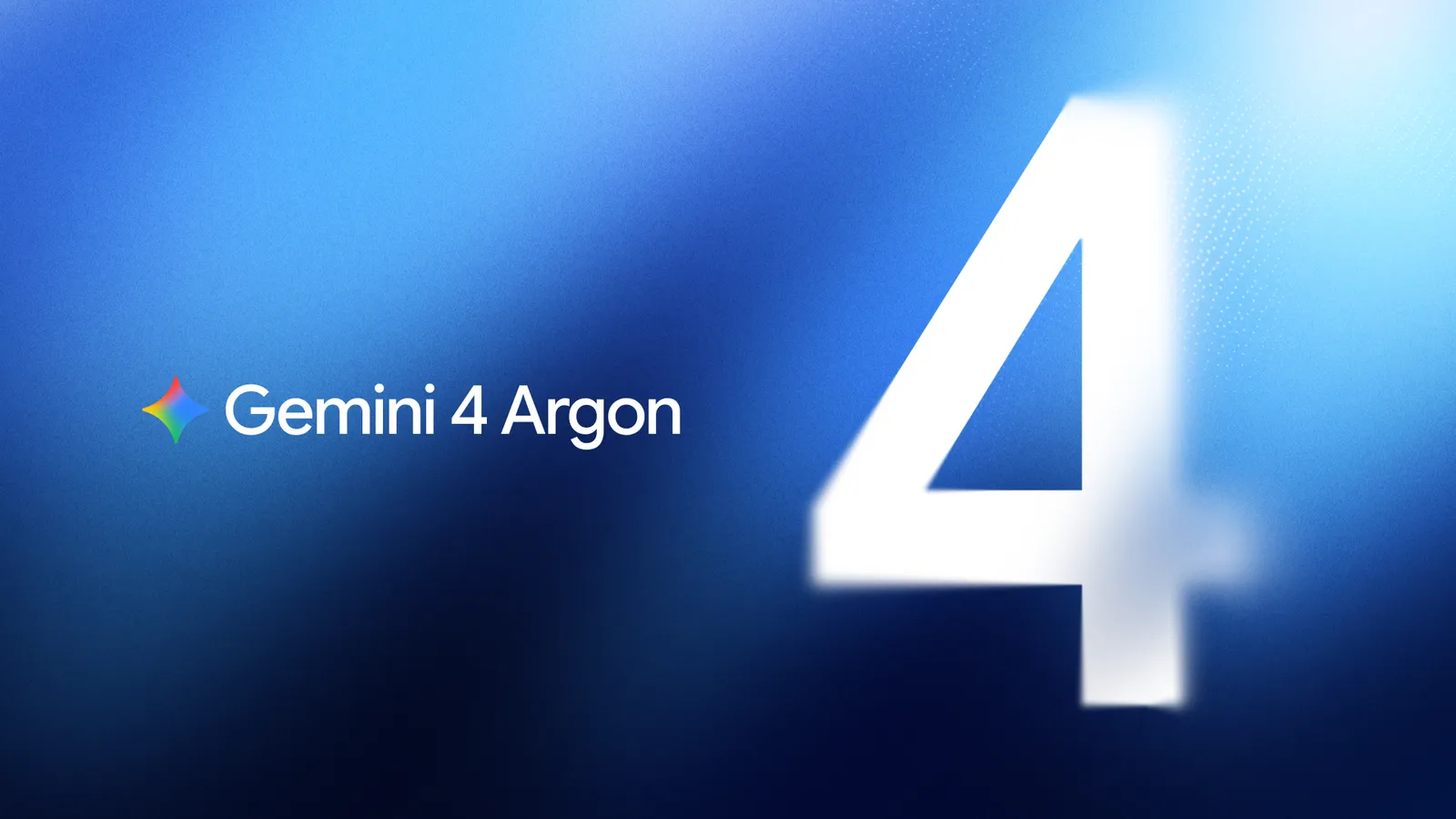
Google promotional artwork for Gemini 4 Argon on a blue gradient background
Image credit: Google — official Gemini 4 Argon launch artwork.

Quick answer: Gemini 4 Argon is announced, but most people cannot use it yet

What it is: Google’s new frontier Gemini model for long-running software engineering, enterprise knowledge work and defensive cybersecurity.

Availability on October 1, 2026: Google says Argon is first being used by a select group of trusted cybersecurity specialists through its Fairwind program. Paid API customers and Google AI Ultra subscribers are next, followed by broader developer, enterprise and consumer access. Google has not published a general release date.

Announced introductory price: $2 per 1 million input tokens and $10 per 1 million output tokens, with cached input discounted by 95%. Google says standard pricing after the introductory period will be $4 input and $20 output per 1 million tokens.

Big technical headline: Google says Argon can produce up to 1,000,000 output tokens, up from a 64K output ceiling in its preceding frontier setup.

Important caveat: the benchmark numbers in this article are Google-published results. They are not independent Digital Pulse Brief testing.

What is Gemini 4 Argon?

Gemini 4 Argon is Google DeepMind’s newest frontier model, announced on September 30, 2026. Google positions it for tasks that are difficult not because they require a single clever answer, but because they demand sustained reasoning across many steps: large code migrations, long-running agent workflows, legal and financial knowledge work, multimodal analysis and defensive cybersecurity.

That positioning matters. Argon is not being introduced as a simple replacement for every lower-cost Gemini model. Google’s own launch material emphasizes complex, high-value workloads where reliability across a long sequence of actions matters more than raw speed or the lowest token price.

The strongest primary references are Google’s September 30 launch announcement and the current Google DeepMind Gemini 4 Argon model page.

Can you use Gemini 4 Argon today?

For most developers and consumers, not yet. Google’s rollout is deliberately phased. That distinction is easy to lose when a model is “announced” but the public API and consumer product are not simultaneously open.

StageWho gets accessStatus
Initial rolloutSelected trusted cybersecurity defenders through FairwindStarted
NextPaid API customers and Google AI Ultra subscribersAnnounced; no general date stated
Broader rolloutMore developers, enterprises and consumersPlanned; timing not specified

DPB also checked Google’s live Gemini Developer API pricing documentation. At the time of publication, that page lists public Gemini 3.x models but does not yet expose an Argon pricing section or public model identifier. Developers should not assume the announcement means a generally callable API endpoint already exists.

Gemini 4 Argon pricing: introductory rates versus standard rates

Google has already announced Argon’s token pricing even though broad API access is still staged. The company says the introductory period will use lower rates before moving to standard pricing.

Pricing phaseInput / 1M tokensOutput / 1M tokensCached input
Introductory$2$1095% discount stated by Google
Standard after intro$4$20No separate post-intro cached rate stated in the same launch announcement

Those rates should be treated as announced Argon pricing, not proof that any Gemini API account can call the model today. Google’s live API pricing page remains the better source for what can actually be purchased through the public developer interface at a given moment.

A model capable of extremely large outputs also needs application-level limits. Developers should set sensible output caps and budgets rather than treating the one-million-token ceiling as a target.

Why the 1-million-token output limit matters

Google says Argon expands maximum output from 64K to 1,000,000 tokens. Output capacity is different from input context: it describes how much the model can generate in a response or sustained workflow, not simply how much source material it can read.

For ordinary chat, one million output tokens is unnecessary. For long-running software work, however, a much larger output budget can reduce the need to split a task into dozens of manually stitched sessions. Potential use cases include multi-file refactors, code migration plans, large structured reports, extended agent traces and research workflows that produce substantial artifacts.

The trade-off is operational. Longer generations can increase cost, latency, review burden and the amount of erroneous output that can accumulate if an early assumption is wrong. Teams should still checkpoint work, validate intermediate results and keep humans in the approval loop for consequential actions.

Google’s benchmark results: impressive, but not a clean sweep

Google’s published table shows Argon leading several enterprise-knowledge, long-context and multimodal tests, but it does not win every benchmark. That is a useful corrective to any “best model at everything” interpretation.

BenchmarkGemini 4 ArgonGPT-6 AstraClaude Fable 5.1Claude Opus 5.5
Vals Index — knowledge work68.9%63.1%65.8%67.0%
AutomationBench51.3%41.4%31.4%42.5%
DeepSWE v1.1 — coding77.9%74.1%67.4%74.2%
FrontierSWE v2 — coding55.0%65.5%56.3%62.3%
Terminal-bench 4.0 — coding57.4%58.2%57.9%66.4%
GraphWalks 256k–1M — long context84.2%71.8%65.0%66.8%
OSWorld-2.0 — computer use69.2%72.6%——
LVBench — multimodal91.7%87.5%79.7%83.7%
CWE-bench v1 — cybersecurity68.0%68.0%58.0%67.0%

Source: Google DeepMind. These are vendor-published evaluation results, not independent DPB tests.
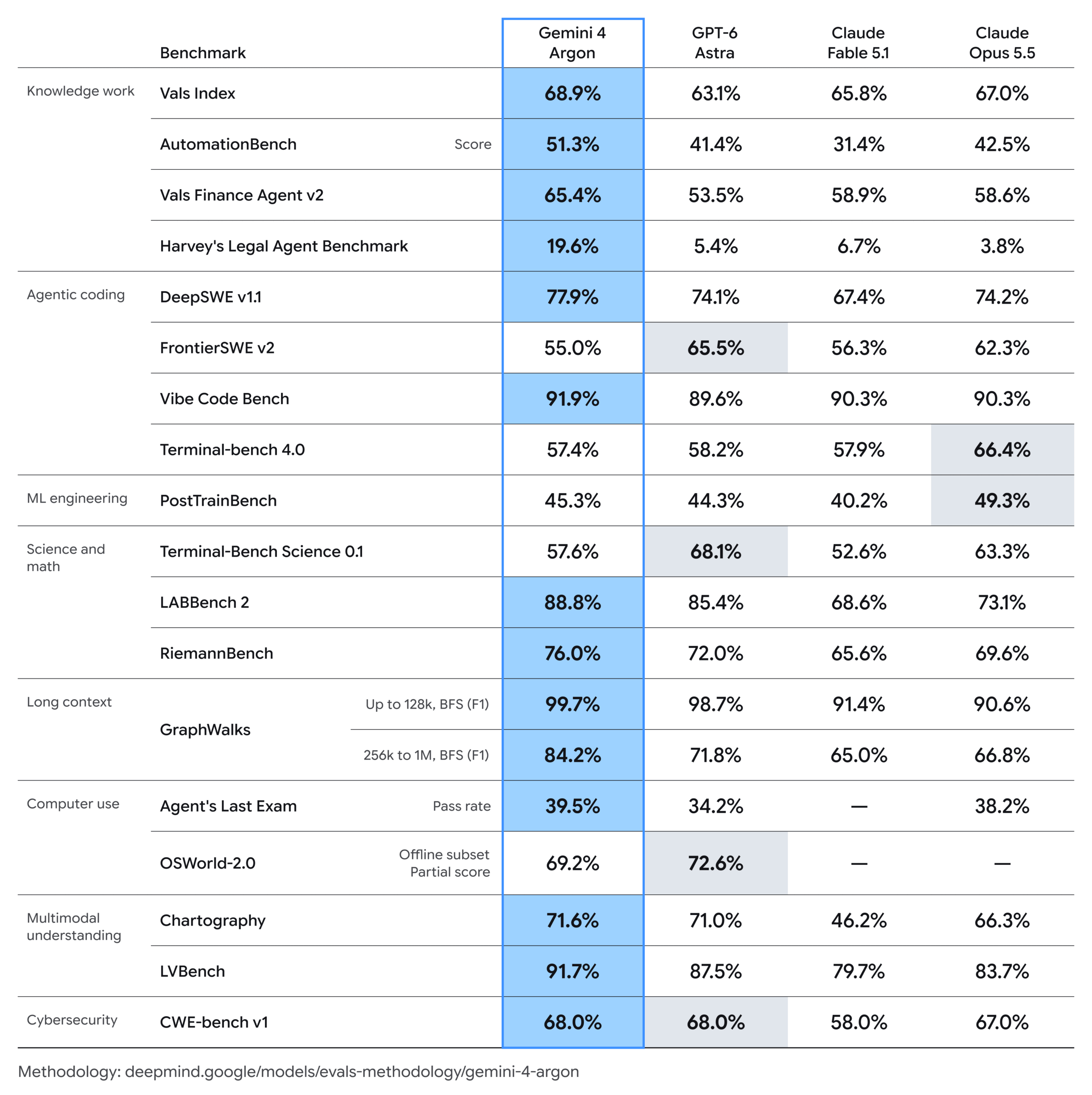
Google benchmark table comparing Gemini 4 Argon with GPT-6 Astra and Claude models
Image credit: Google DeepMind — official published benchmark comparison.

Argon looks particularly strong in Google’s knowledge-work, long-context and multimodal evaluations, while GPT-6 Astra or Claude Opus 5.5 lead some coding, science or computer-use rows. See Google’s evaluation methodology for test conditions.

For competitor context, DPB’s Claude Opus 5.5 explainer and OpenAI DevDay 2026 recap cover the surrounding model ecosystem.

What Google says Argon is already doing internally

Google’s launch announcement includes several internal examples intended to show why it built Argon for long, difficult workflows. These are Google’s own reports, not independently reproduced DPB measurements.

  • Quantum algorithm work: Google says Argon improved a baseline algorithm by 40% within minutes.
  • Memory efficiency: Google reports that Argon helped free more than 300 TiB of memory, with a projected total opportunity of roughly 500 TiB to 1 PiB.
  • Large code migrations: Google says the model assisted C/C++ to Rust migration work, including codebases involving more than 800,000 lines in the Zircon kernel and work around libgav1.

The editorially important point is the task shape: these examples involve navigating large systems, making many dependent changes and preserving coherence over time. They fit Google’s stated reason for increasing the model’s long-horizon reasoning and output capacity.

Cybersecurity is the first rollout — and the most sensitive one

Google is giving Argon’s earliest access to trusted cybersecurity defenders through its Fairwind program. The DeepMind page says the model is designed to help defensive teams identify, validate and remediate software weaknesses, while Google’s CWE-bench v1 result is 68%, tied with GPT-6 Astra in the company’s published comparison.

That does not mean autonomous security should replace engineering review. This is a dual-use area, and Google says the phased rollout is paired with safeguards for harmful requests, monitoring for misalignment, protections against indirect prompt injection and hardened sandbox environments.
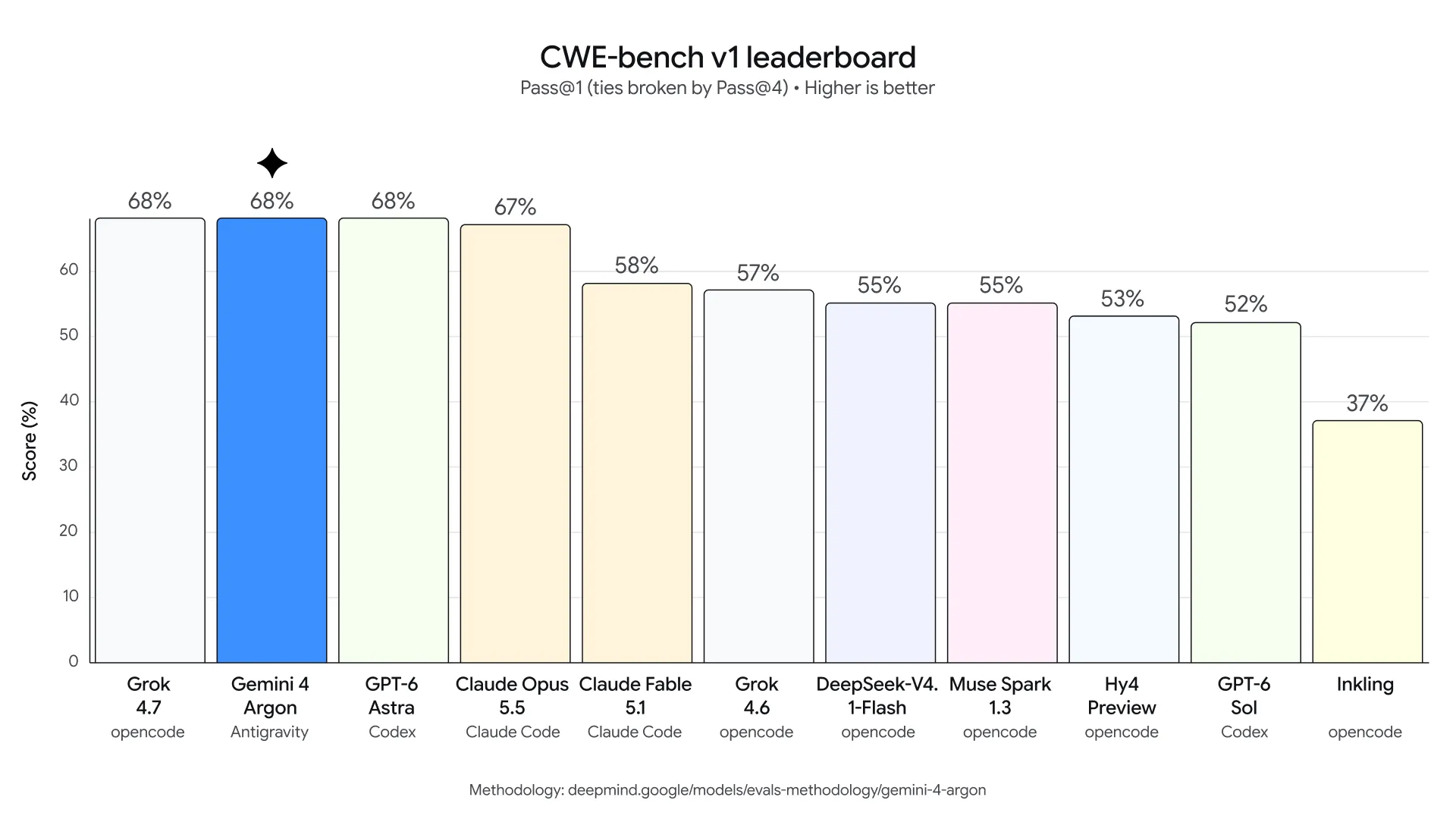
Google CWE-bench v1 chart comparing Gemini 4 Argon with other frontier AI models
Image credit: Google DeepMind — CWE-bench v1 comparison published with the Gemini 4 Argon launch.

Google describes Argon as its most resilient model yet against indirect prompt-injection attacks. That is a company claim, not a guarantee that prompt injection is solved. Sensitive deployments should still use least-privilege permissions, isolated environments, audit logs and human approval for consequential actions.

For related defensive architecture, see DPB’s guide to NVIDIA OpenShell and Sentry.

What developers and businesses should do before Argon reaches them

  1. Do not code against an assumed model ID. Google’s public developer pricing documentation does not yet expose a generally available Argon API entry, so wait for official API documentation rather than guessing the identifier.
  2. Separate announced pricing from accessible pricing. Use Google’s announced rates for planning, but confirm the live API price and availability when your account actually receives access.
  3. Benchmark on your own workload. A legal, long-context or coding benchmark may not predict performance on your documents, repositories, latency targets or quality thresholds.
  4. Use output limits deliberately. The one-million-token ceiling expands what is possible, but applications should request only the output that adds value.
  5. Keep high-impact actions gated. For code changes, security remediation, financial analysis or enterprise workflows, require review before consequential actions are executed.
  6. Track the rollout. Google says paid API users and AI Ultra subscribers are next, but the launch announcement gives no broad-release date.

Gemini 4 Argon versus the models you can use now

Argon’s launch makes frontier-model comparisons more interesting, but availability is part of the product. A model you cannot yet call in production is not a direct replacement for an API you can deploy today.

Google’s current Gemini API pricing page still lists public Gemini 3.x options, while OpenAI and Anthropic have their own production model lines. Teams with an immediate deadline should evaluate models actually available in their region and account today, then rerun the same evaluation suite when Argon access arrives.

That avoids a common launch-week mistake: redesigning a production stack around announcement-day benchmark claims before rate limits, SDK support, regional availability and operational behavior have been tested in the real deployment environment.

FAQ

Is Gemini 4 Argon available to everyone?

No. As of October 1, 2026, Google says initial access is with selected trusted cybersecurity specialists through Fairwind. Paid API customers and Google AI Ultra subscribers are next. Google has not provided a general release date.

How much will Gemini 4 Argon cost?

Google announced introductory pricing of $2 per 1 million input tokens and $10 per 1 million output tokens, with cached input discounted by 95%. It says standard pricing after the introductory period will be $4 input and $20 output per 1 million tokens.

Does Gemini 4 Argon support one million output tokens?

Google says yes: Argon raises its maximum output to 1,000,000 tokens. That is an output limit, not a reason every application should generate responses anywhere near that size.

Is Gemini 4 Argon better than GPT-6 Astra or Claude Opus 5.5?

There is no defensible universal answer from launch-day data. In Google’s published table Argon leads many knowledge-work, long-context and multimodal tests, but competing models lead several coding, science and computer-use rows. Independent workload-specific testing matters more than one vendor scoreboard.

Is Gemini 4 Argon safe from prompt injection?

Google says Argon is its most resilient model yet against indirect prompt injection, but that is not the same as saying prompt injection is impossible. Sensitive deployments still need isolation, least privilege, monitoring and human approval controls.

How Digital Pulse Brief researched this article

DPB reviewed Google’s September 30, 2026 launch announcement, the live Google DeepMind Gemini 4 Argon model and benchmark page, Google’s benchmark-methodology link, and the current Gemini Developer API pricing documentation. We distinguish Google’s claims from independently verified facts.

No Digital Pulse Brief hands-on testing of Gemini 4 Argon is claimed here because broad public access is not yet available. The visual assets used in this article come from Google’s official launch materials and are credited to Google/Google DeepMind.

Primary sources: Google launch announcement · Google DeepMind model page · Gemini API pricing · evaluation methodology.

What to watch next

The next meaningful update is the moment Google publishes the public Argon model identifier, rate limits, API documentation, region availability and confirmed access path for paid developers and AI Ultra subscribers. Those details will determine how quickly the model moves from an announcement into real production use.

Digital Pulse Brief will update this URL when material access, pricing or capability information changes rather than creating a duplicate page for the same search intent.

Explore more coverage in AI & Automation. If you spot a factual error or material rollout change, use Digital Pulse Brief’s contact page so the editorial desk can review it.

DIGITAL PULSE BRIEF NEWSLETTER

Get clear AI, technology and business insights in your inbox

Breaking developments, practical explainers, reviews and useful tech intelligence — without the noise.