
AI & AUTOMATION · SPACE ROBOTICS
NASA’s AI Robot Fleet Can Replan Science Missions on Its Own — Here’s How ASTRA Works
NASA’s ASTRA project has field-tested a three-robot AI system that can weigh scientific value, risk, distance and changing conditions without waiting for constant instructions from Earth. The important advance is not simply autonomous driving: it is letting a robotic team decide what deserves attention next while staying inside human-defined science goals.
Published September 21, 2026 · Research-based explainer · About 12 minutes
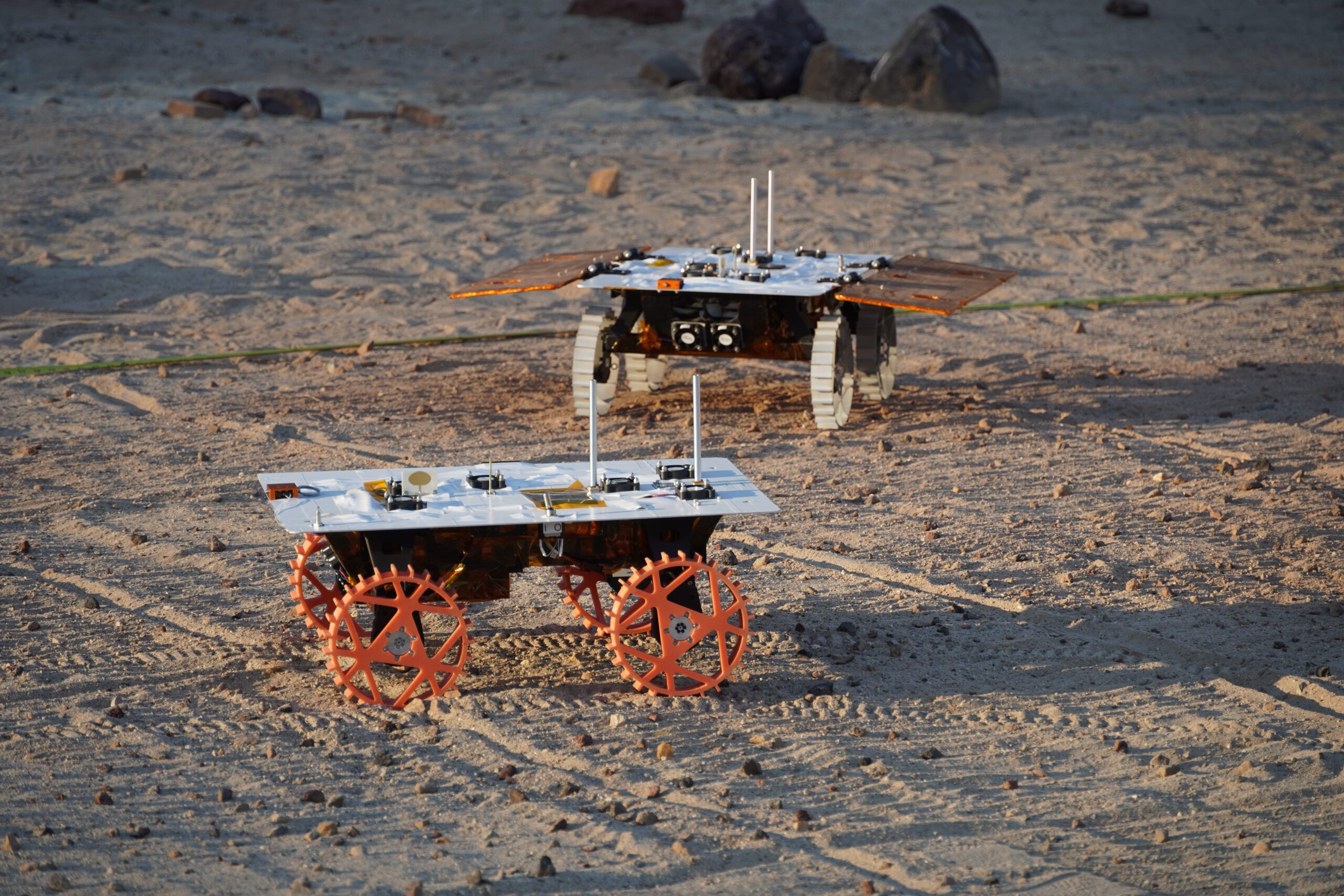
Real NASA CADRE development rovers during cooperative autonomous testing in JPL’s Mars Yard. This is related multirobot-autonomy context, not a photo from the July 2026 ASTRA field test. Credit: NASA/JPL-Caltech. Official JPL source. Used for editorial reporting under the JPL Image Use Policy.
Quick answer
In July 2026 at the Virginia Tech Transportation Institute in Blacksburg, Virginia, NASA’s Adaptive Sensing Technology for Responsive Autonomy (ASTRA) team and partners tested a fleet made up of a scouting drone and two ground rovers. Humans supplied the overall science goals. The robots then evaluated where to go, which machine was best for each task, whether the scientific payoff justified the risk, and how to respond when new targets appeared.
The field test showed the fleet could keep pursuing its original objective while also allocating another robot to investigate a newly discovered point of interest. NASA’s long-term aim is a trustworthy robotic extension of a human science team for places where communications delays, terrain or danger make continuous human control impractical.
Key distinction: ASTRA is not a free-roaming AI deciding its own mission. Human scientists define priorities and acceptable risk; the fleet makes local mission decisions inside those boundaries.
What NASA actually tested
NASA published the ASTRA field-test results on September 15, 2026. According to the agency’s official fieldwork report, three robots worked together as a small science team during testing conducted in July at the Virginia Tech Transportation Institute.
The roles were deliberately different. A drone carried environmental and scientific sensors and scouted from above. One ground rover used lidar to build a detailed map, support navigation and gather context. A second rover carried a robotic arm that could collect samples. Rather than assigning every move from a control room, the software evaluated the assets available and matched them to the science opportunity.
That division of labor matters. Planetary exploration is rarely one problem. A mission may need broad reconnaissance, precision mapping and physical sampling at the same time. ASTRA is an attempt to make those capabilities behave like a coordinated field team rather than three independent machines waiting for separate command queues.
NASA says the test involved partners including Noblis, Aurora Engineering and the University of Tulsa, with Bethany Theiling of NASA Goddard serving as ASTRA principal investigator and field lead.

Three real NASA CADRE rovers during a team-autonomy drive test in a JPL clean room. Related autonomy context; not an ASTRA test image. Credit: NASA/JPL-Caltech. Official JPL source. Used for editorial reporting under the JPL Image Use Policy.
How the AI fleet’s decision loop works
A conventional autonomous rover can avoid obstacles or follow a preplanned route. ASTRA is targeting a higher-level problem: deciding which scientific action is most valuable when conditions and priorities compete.
| Stage | What happens | Why it matters |
|---|---|---|
| 1. Human objective | Scientists define the mission goal and priorities. | Humans retain control over what the mission is trying to achieve. |
| 2. Scout | The drone surveys an area and identifies points of interest. | The fleet can discover opportunities that were not known before arrival. |
| 3. Evaluate | Software compares science payoff, distance, speed, asset availability and risk. | Different kinds of evidence can be considered together. |
| 4. Assign | The fleet chooses which robot is best suited to investigate. | A mapping rover does not have to be used for a job better suited to the sampling rover. |
| 5. Reassess | Robots monitor hazards and new information while the plan is underway. | The plan can change without waiting for a fresh command from Earth. |
| 6. Report | The fleet communicates results and decisions back to the human team. | Autonomy remains accountable to mission managers rather than becoming opaque independence. |
The most revealing test involved a new area of interest appearing after the fleet had already started its work. NASA reports that the system did not abandon its original objective. Instead, it paused to evaluate the opportunity and brought in another robotic asset to investigate the new question.
That behavior is closer to how a skilled field team works: protect the core assignment, recognize a potentially valuable surprise, and decide whether there is enough capacity to pursue both.

The real ERNEST rover during a 2026 JPL desert autonomy field test. ERNEST is a separate NASA/JPL rover project, shown here as related long-range autonomy context. Credit: NASA/JPL-Caltech. Official JPL source. Used for editorial reporting under the JPL Image Use Policy.
Why autonomy matters more the farther missions travel
On Earth, a remote robot can often rely on fast networks and nearby operators. Planetary missions cannot. The farther a spacecraft travels, the less practical it becomes for humans to approve every turn, sample or change of plan in real time.
NASA describes ASTRA’s goal as creating a trustworthy extension of the human science team for environments where people are too far away to provide continuous instructions or where direct human exploration would be unacceptably risky. That includes difficult terrain on the Moon and Mars and, potentially, uncrewed missions farther into the solar system.
The efficiency problem is as important as the communications problem. A rover may have a limited lifetime, limited power, a narrow communications window and only a few chances to collect a valuable sample. Waiting for Earth to evaluate every unexpected observation can consume scarce mission time.
Autonomy therefore changes the economics of exploration. A robotic fleet that can safely prioritize its own next measurement may return more science from the same launch, power budget and operating window.
NASA/JPL is already pushing this idea in other programs. In June 2026, JPL reported that the ERNEST prototype traveled about 16 miles during a desert field test with minimal intervention, while engineers refined mobility and autonomy software for challenging terrain. The details differ from ASTRA, but the direction is similar: move decision-making closer to the robot.

A completed NASA CADRE rover in a JPL clean room. CADRE is a separate lunar technology demonstration built around cooperative rover autonomy. Credit: NASA/JPL-Caltech. Official JPL source. Used for editorial reporting under the JPL Image Use Policy.
Why this is more than a “robot swarm” headline
Calling ASTRA a robot swarm is catchy, but it can hide the interesting part. The system is not simply trying to make multiple machines move together. It is trying to represent human scientific priorities in a way machines can use when choosing among competing actions.
NASA says the decision process considers objective inputs—such as which robots are available, how far away they are and how quickly they can move—alongside more subjective mission judgments. How valuable would a map of one location be compared with a physical sample from another? How much risk would the human team accept for that information? Should a newly discovered feature outrank the original plan?
Those questions cannot be reduced to shortest-path navigation. They are closer to mission planning under uncertainty. The AI system needs enough flexibility to respond to what it sees without quietly redefining what success means.
What this means: ASTRA’s most important capability is not “robots acting without humans.” It is robots making bounded, explainable tradeoffs on behalf of humans when immediate guidance is unavailable.

A NASA CADRE rover undergoing electromagnetic-interference testing at JPL. Reliable autonomous systems still depend on conventional hardware qualification and communications engineering. Credit: NASA/JPL-Caltech. Official JPL source. Used for editorial reporting under the JPL Image Use Policy.
ASTRA vs. CADRE vs. Perseverance: three different layers of autonomy
ASTRA sits in a broader NASA push toward increasingly capable autonomous exploration. Three current examples illustrate the progression.
| Program | Main autonomy problem | What is distinctive |
|---|---|---|
| ASTRA | Science-priority and task decisions across a mixed fleet. | Balances risk, value and changing information against human goals. |
| CADRE | Cooperative exploration by multiple similar lunar rovers. | Three rovers share information and coordinate routes as a team. |
| Perseverance AI drive | Route planning for one operational Mars rover. | A vision-capable generative AI created waypoints from orbital imagery and terrain data. |
JPL’s CADRE mission is designed around three carry-on-size rovers that communicate through a mesh network and work together on the Moon with limited direct intervention. In testing, development rovers drove in formation, adjusted plans around obstacles and paused the team when one rover’s battery was low.
Separately, NASA announced in January 2026 that Perseverance completed the first drives on another world whose waypoints were planned by generative AI. JPL says a vision-language model analyzed orbital imagery and terrain data to identify hazards and propose a safe route. Digital Pulse Brief has also covered increasingly agentic AI systems in our GPT-6 Astra agent explainer; space autonomy is a useful counterexample because every action must operate under physical constraints and expensive failure modes.
Official NASA/JPL video: Perseverance Rover’s view of its AI-planned crater-rim drive. Source: NASA/JPL-Caltech.
The hard problems: trust, risk and failure
The July field test is promising, but it is still a field test. NASA has not said that ASTRA is flying on a specific planetary mission, and the public report does not provide enough information to judge reliability across every environment a future mission could encounter.
The central challenge is trust. A robotic scientist can be useful only if mission teams understand why it selected one target over another, how it handled uncertainty and when it should stop rather than improvise. A wrong suggestion in a terrestrial AI assistant may waste minutes. A poor autonomous decision on another world can consume irreplaceable power, damage hardware or forfeit a scientific opportunity.
Risk preferences are also mission-specific. A low-cost scout might be allowed to approach unstable terrain that would be unacceptable for a one-of-a-kind sampling rover. ASTRA’s focus on combining physical capability, science value and human-defined risk tolerance is therefore essential rather than decorative.
Cybersecurity and software integrity matter too. Multi-robot autonomy increases the number of sensors, communications links, software components and inter-robot dependencies that must behave as expected. The fleet needs graceful fallback modes when data is inconsistent, a sensor fails or communications degrade.
This is also why NASA’s other rover programs still invest heavily in conventional testing. Autonomy does not replace electromagnetic compatibility tests, hardware qualification, route validation or human mission governance; it sits on top of those layers.

A real NASA CADRE rover during lunar-deployer testing at JPL. Even highly autonomous robots depend on carefully engineered deployment and recovery procedures. Credit: NASA/JPL-Caltech. Official JPL source. Used for editorial reporting under the JPL Image Use Policy.
What to watch next
The next milestone is not simply “more AI.” The meaningful question is whether NASA can move this decision-making architecture from an Earth analog test into mission-qualified systems with demonstrable reliability, interpretable tradeoffs and safe fallback behavior.
A useful progression would include more varied terrain, longer-duration tests, degraded communications, sensor failures and cases where two science goals genuinely conflict. Those situations would reveal whether the fleet can preserve mission priorities when the obvious answer disappears.
ASTRA also becomes more interesting when paired with advances already happening elsewhere in NASA robotics: cooperative rovers such as CADRE, long-range mobility work such as ERNEST, and AI-generated route planning demonstrated with Perseverance. The long-term architecture could be a hierarchy in which individual machines navigate themselves, teams coordinate resources, and mission-level AI decides which scientific opportunities deserve attention.
For readers following NASA’s growing use of advanced computing, Digital Pulse Brief recently covered the Roman Space Telescope’s first-photon and instrument-activation milestones. ASTRA shows a different side of the same shift: future missions will depend not only on better sensors, but on software capable of deciding how best to use them.
Frequently asked questions
What is NASA ASTRA?
ASTRA stands for Adaptive Sensing Technology for Responsive Autonomy. It is a NASA-led effort to let robotic science assets evaluate opportunities, risks and mission priorities when immediate human instructions are unavailable.
Did NASA test ASTRA in space?
No. The field test described by NASA took place in July 2026 at the Virginia Tech Transportation Institute in Blacksburg, Virginia. It was an Earth-based test of the fleet’s decision-making behavior.
How many robots were in the test?
Three: a scouting drone, a rover equipped for lidar mapping and navigation context, and a rover with a robotic arm for sample collection.
Does ASTRA replace human scientists?
No. Humans define the scientific goals, priorities and acceptable risk. The system is designed to make local decisions inside those constraints and report back to mission managers.
Is ASTRA the same as NASA’s CADRE mission?
No. CADRE is a separate JPL technology demonstration focused on three small lunar rovers cooperating autonomously. ASTRA is focused more broadly on mission-level scientific decision-making across different robotic assets.
Bottom line
NASA’s ASTRA test is significant because it moves autonomy up the decision stack. The question is no longer only whether a robot can drive safely. It is whether a robotic team can decide which scientific opportunity deserves attention, select the right asset and adapt when the environment changes—without losing sight of goals set by humans.
If that approach survives the much harder path from field testing to flight qualification, it could let distant missions do more science in the time between communications with Earth. The payoff would be greatest where every minute, watt and movement matters.
Sources and image-use record
This is a research-based explainer. Digital Pulse Brief did not participate in the ASTRA test. Factual details are based primarily on NASA and JPL first-party sources. Images used in the article are real NASA/JPL photographs from related autonomy and robotics programs; captions identify when an image is contextual rather than from ASTRA’s July 2026 test.
- NASA — Field-Tests AI Fleet Capability for Science, Exploration (September 15, 2026)
- NASA/JPL — CADRE mission
- NASA/JPL — Perseverance completes first AI-planned drive on Mars (January 30, 2026)
- NASA/JPL — ERNEST advanced rover testing (June 18, 2026)
- JPL Image Use Policy — permits journalistic/editorial use with required credit and no implied endorsement.
- NASA Images and Media Usage Guidelines
You may also like
DIGITAL PULSE BRIEF NEWSLETTER
Get clear AI, technology and business insights in your inbox
Breaking developments, practical explainers, reviews and useful tech intelligence — without the noise.
WHAT TO READ NEXT
New Microsoft Copilot 2026: Home, Code and Autopilot Turn Copilot Into a Work Operating Layer  Claude Opus 5.5 Explained: Pricing, Coding Gains, Safety Changes and Who Should Use It
  Gemini 3.8 Live Avatar Is Now GA: 97 Languages, Custom Avatars, SynthID and Enterprise Use
MORE FROM DIGITAL PULSE BRIEF