
AI & AUTOMATION · GPT-6
GPT-6 Sol vs GPT-6 Luna: API Pricing, Benchmarks, Availability and Which Model Fits Your Work
OpenAI’s new GPT-6 Sol and GPT-6 Luna are less about a new benchmark crown than a cheaper operating model for AI at scale. Sol targets complex coding and agentic work; Luna targets high-volume tasks where cost and speed matter more than maximum reasoning depth.
Published September 22, 2026 · Research-based analysis using OpenAI, GitHub and Reuters · Digital Pulse Brief has not independently benchmarked these models

OpenAI headquarters context. Photo: Coolcaesar / Wikimedia Commons, CC BY 4.0. Source file. Resized for web; no creative alteration claimed.
Quick answer
GPT-6 Sol is the better fit when the cost of a wrong or incomplete result is higher than the cost of extra inference. It is priced at $2 per million input tokens and $10 per million output tokens. GPT-6 Luna is the volume model: $0.10 input and $0.50 output per million tokens.
OpenAI says both are 50% cheaper than the GPT-5.6 promotional rates they replace, although Luna’s output price actually falls from $1.20 to $0.50—a 58.3% reduction. For a workload using 100 million input tokens and 20 million output tokens per month, the launch prices work out to roughly $400 on Sol, $20 on Luna, and $2,000 on Astra, before caching or other service-tier effects.
The practical takeaway is to route by task risk. Use Luna for bounded, repeatable jobs; Sol for coding and multistep agents; Astra when quality ceiling matters enough to justify a 5× Sol token price.
What OpenAI actually launched on September 22
OpenAI added two lower-cost models to the GPT-6 family: GPT-6 Sol and GPT-6 Luna. Astra remains the top tier. The new models are available through the API as gpt-6-sol and gpt-6-luna, and OpenAI is also rolling them into ChatGPT Work and Codex.
The naming can obscure the product strategy. This is not simply “Astra, but smaller.” OpenAI is separating three different economic problems. Astra is the quality-first option for the hardest work. Sol is intended to preserve much of the new generation’s professional, coding and computer-use capability at a much lower cost. Luna is the throughput tier, where teams can afford to run far more calls, retries and background jobs.
That distinction matters because agent systems spend money differently from ordinary chat. A user may send a few prompts; an agent can make dozens or hundreds of model calls while browsing, coding, checking its work and using tools. Once a workflow becomes iterative, cost per successful task is often more useful than cost per single prompt.
OpenAI branding in a technology-hardware setting; contextual imagery rather than a GPT-6 interface screenshot. Photo: Focal Foto / Wikimedia Commons, CC BY-SA 4.0. Source file.
GPT-6 Sol and Luna API pricing: the gap is intentionally huge
OpenAI’s launch rates are quoted per one million tokens. Sol costs $2 for input and $10 for output. Luna costs $0.10 for input and $0.50 for output. Astra remains $10 input and $50 output.
| Model | Input / 1M | Output / 1M | 100M input + 20M output | Best economic fit |
|---|---|---|---|---|
| GPT-6 Luna | $0.10 | $0.50 | $20 | High-volume, bounded work |
| GPT-6 Sol | $2 | $10 | $400 | Complex coding and agents |
| GPT-6 Astra | $10 | $50 | $2,000 | Highest-stakes / hardest tasks |
The example is simple arithmetic using OpenAI’s standard token prices; it is not a prediction of a real bill. Tool calls, cached input, service tiers, retries and output length change production costs.
A useful pricing nuanceOpenAI describes both new models as 50% cheaper than their GPT-5.6 promotional pricing. Sol is exactly half price on both input and output. Luna input is also halved, but Luna output falls from $1.20 to $0.50—about 58.3%. That means Luna’s blended savings can exceed 50% for output-heavy workloads.
The benchmark story is about cost per completed task
OpenAI’s strongest case for Sol is not that it beats Astra. It does not. The case is that Sol can get close enough to premium-model results while spending much less.
On AutomationBench, which tests end-to-end business workflows across 47 tools, OpenAI reports 33.2% for GPT-6 Sol at xhigh effort, compared with 30.3% for GPT-6 Astra at low effort and 26.9% for Claude Opus 5 at max effort. OpenAI puts Sol’s cost at $0.27 per task in that setup; Astra low cost 3.9× as much and Opus 5 max 11.1× as much.
That is a useful result, but it is not a universal ranking. Effort settings differ, vendor harnesses differ, and OpenAI notes that its competitor measurements come from public reports. OpenAI also says its Claude Fable 5.1 cost comparison understates actual cost because fallback calls to Opus 5 were not fully reported. The right interpretation is “promising cost-performance under this evaluation,” not “Sol is always better.”
On DeepSWE 1.1, GPT-6 Sol at max effort scores 68.8%, within 1.1 percentage points of Claude Fable 5’s highest reported score in OpenAI’s comparison. GPT-6 Luna reaches 66.6% at max effort. On OSWorld 2.0 offline, Sol xhigh scores 60.5% versus 60.3% for Claude Opus 5 at medium effort.
Selected launch benchmark results
AutomationBench — GPT-6 Sol xhigh: 33.2%
DeepSWE 1.1 — GPT-6 Sol max: 68.8%
DeepSWE 1.1 — GPT-6 Luna max: 66.6%
OSWorld 2.0 offline — GPT-6 Sol xhigh: 60.5%
Source: OpenAI launch evaluations. These are not Digital Pulse Brief tests and should not be compared across benchmarks as if they measured the same skill.

OpenAI CEO Sam Altman speaking at TED in April 2025. Photo: Steve Jurvetson / Wikimedia Commons, CC BY 2.0. Source file. Resized for web.
Factuality improved, but OpenAI’s test has an important limitation
OpenAI says GPT-6 Sol makes about half as many mistakes as GPT-5.6 Sol on an internal factuality evaluation built from de-identified ChatGPT conversations where users had flagged errors. Luna also improves, and OpenAI says higher-effort Luna can match GPT-5.6 Sol at roughly one-hundredth the cost in that evaluation.
The methodology matters. These are conversations already selected because users noticed a factual problem. OpenAI explicitly says they are not representative of typical usage, where errors are rarer. They also cannot measure mistakes that users failed to notice or report. So the result is evidence of improvement on a hard error-focused set, not an independently measured hallucination rate for normal production traffic.
For teams replacing a more expensive model with Luna or Sol, the correct migration test is still workload-specific: assemble real prompts, score the outputs with the same acceptance criteria you use in production, and compare cost per accepted result. A cheaper model that needs two retries can erase part of its nominal token-price advantage.
A practical routing strategy: Luna first, Sol when ambiguity rises, Astra when failure is expensive
The pricing spread creates an obvious temptation to send everything to Luna. That can be sensible for structured work, but the better approach is to route by uncertainty and consequence.
| Workload | Start with | Escalate when |
|---|---|---|
| Extraction, classification, short summaries | GPT-6 Luna | Schema failures or ambiguous source material rise |
| High-volume background agents | GPT-6 Luna | A task becomes multi-step, open-ended or tool-heavy |
| Production coding and codebase changes | GPT-6 Sol | Architecture, security or difficult debugging dominates |
| Computer-use workflows | GPT-6 Sol | The cost of a wrong action is high or the workflow is unusually complex |
| Highest-stakes reasoning / hardest professional tasks | GPT-6 Astra | Use a cheaper tier only after your own evals show acceptable quality |
This is a cost-control framework, not a claim that one model will always outperform another on every prompt. A well-designed router should be able to escalate based on failed validation, low confidence, tool errors or explicit task classes rather than guessing from prompt length alone.
Prompt caching may matter as much as the headline price cut
OpenAI says GPT-6 improves cache hit rates by default and discounts cached input-token reads by 90%. For agent systems with long, repeated instructions, tool definitions and conversation history, that can change the economics more than a small benchmark gain.
At the new standard input rates, a 90% cached-input discount implies an effective cached-input rate of about $0.20 per million tokens for Sol and $0.01 for Luna, before any other pricing tier. That is a derived calculation from OpenAI’s published rates and cache discount, not a separate quoted price.
OpenAI also says developers can preserve cache reuse while changing reasoning effort or enabling and disabling tools, and can define explicit cache breakpoints. GitHub told OpenAI that caching improvements reduced the share of prompt tokens requiring fresh processing by more than 50% across billions of requests to OpenAI models.
For production teams, the actionable metric is cache-hit rate by workflow. If every agent run rebuilds a long system prompt, schema and tool catalog from scratch, model selection is only half the optimization problem.
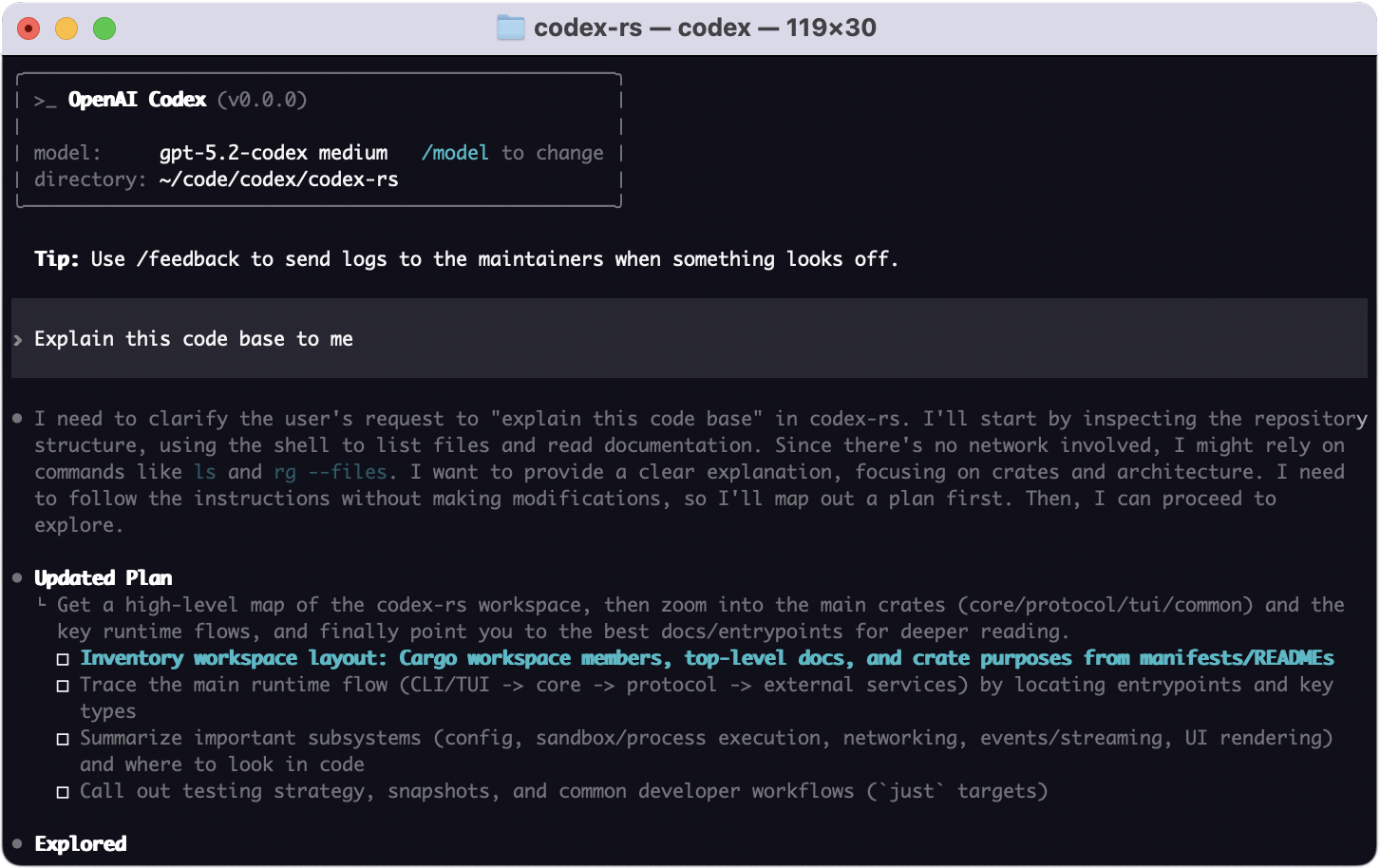
OpenAI Codex CLI running on macOS, useful context for the long-running coding-agent workloads discussed here. Source: OpenAI/Codex GitHub repository via Wikimedia Commons, Apache License 2.0. Source file.
Coding is where Sol’s economics are easiest to justify
Coding agents are unusually expensive because they repeatedly inspect files, reason about a change, write code, run tests, read failures and try again. OpenAI says daily token use by its own researchers, valued at API prices, has exceeded $600 for the median researcher and $7,000 at the 90th percentile. Those figures describe OpenAI’s internal usage, not a normal developer bill, but they show why model cost compounds quickly in long-running agents.
Sol is positioned directly at that problem. Its DeepSWE and FrontierCode results suggest it can handle substantial software-engineering tasks without forcing every iteration onto Astra. Luna is more interesting for supporting tasks: quick code explanation, log classification, repetitive transformations, lightweight test generation or first-pass triage before escalation.
GitHub’s launch-day Copilot support reinforces that split. GitHub describes Sol as a balanced option for interactive and agentic coding, while Luna is its lightweight, cost-efficient choice for smaller and faster tasks. Sol is available to Copilot Pro+, Max, Business and Enterprise; Luna also reaches Copilot Pro.
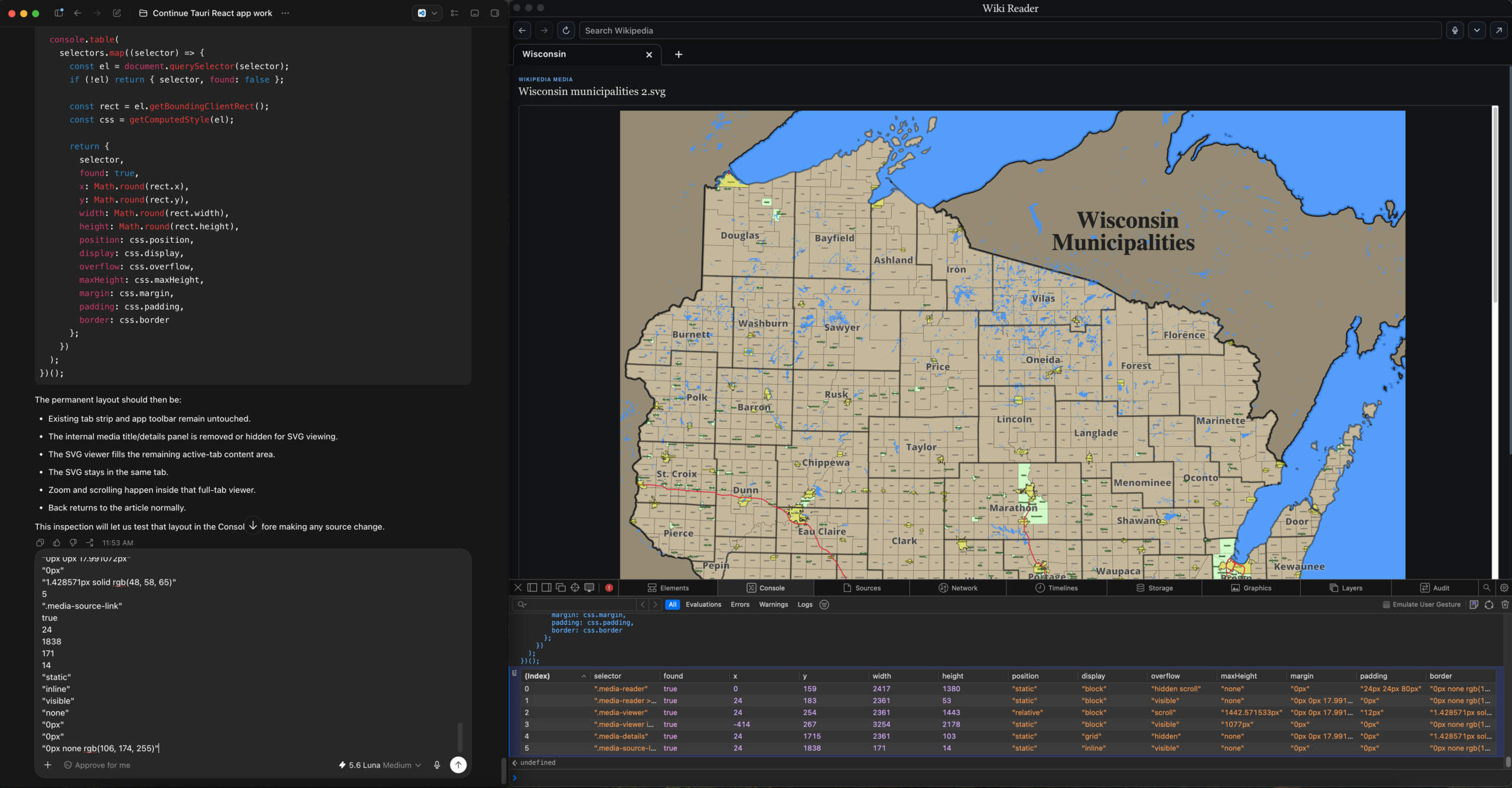
A real Codex development workflow using a Tauri application and DOM inspector. Screenshot: Wikideas1 / Wikimedia Commons, CC0 1.0. Source file. Shown as workflow context, not benchmark evidence.
Where GPT-6 Sol and Luna are available now
At launch, OpenAI says both models are available in ChatGPT Work and Codex for Plus, Pro, Business, Enterprise and Edu users. Free and Go users can access GPT-6 Luna in the desktop app. API developers can call gpt-6-sol and gpt-6-luna.
OpenAI’s announcement also says the models were not yet generally available in Chat at the moment of publication and would roll out gradually through the day. That distinction matters for users who see headlines before the model picker updates on their account. Availability can also differ by product surface, plan and rollout state.
OpenAI did not announce a GPT-6 Terra model in this release. The current launch adds Sol and Luna below Astra; users should not assume a GPT-6 Terra SKU exists until OpenAI documents one.
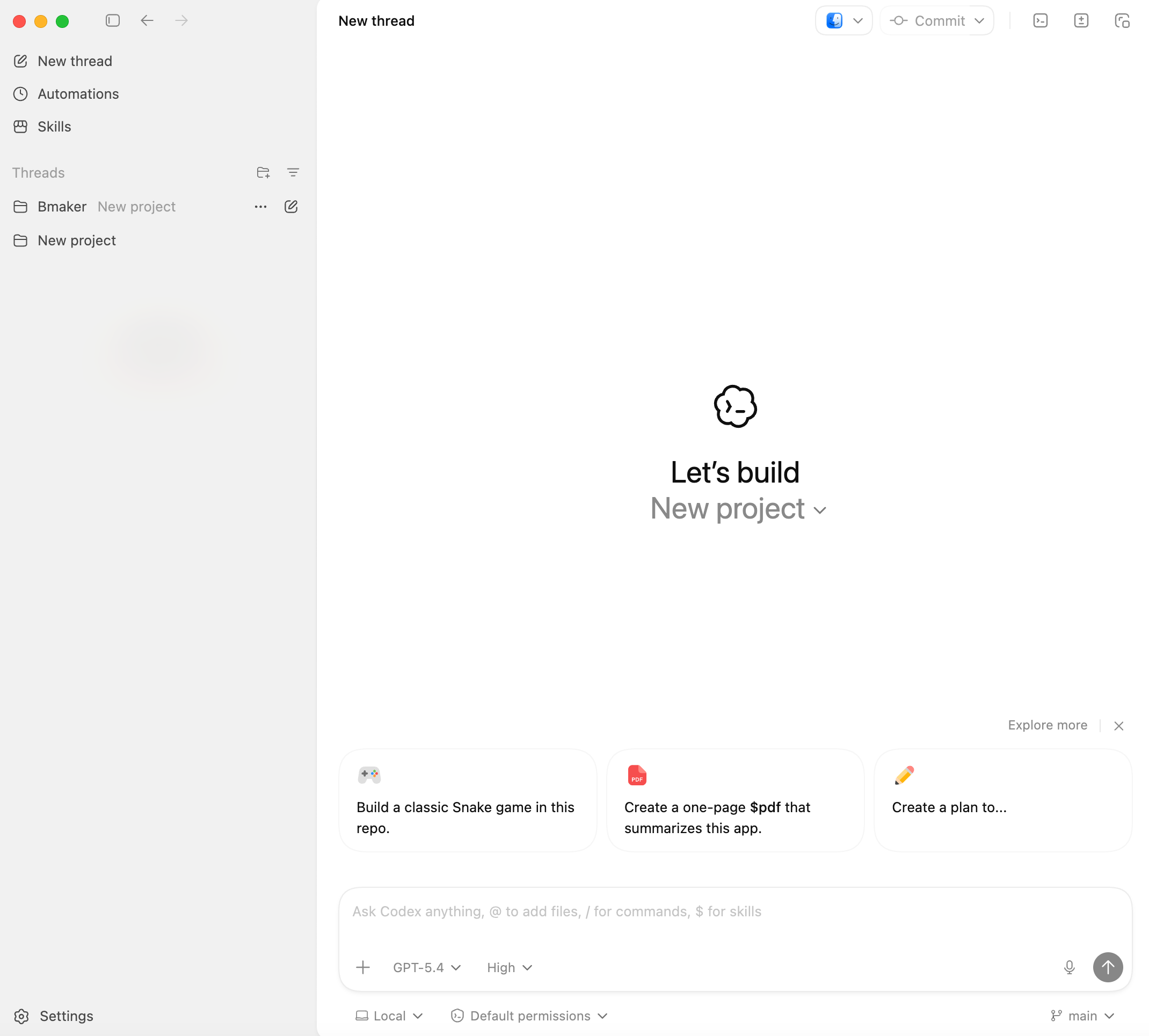
OpenAI Codex desktop app start screen for a local project. Screenshot: Esculenta / Wikimedia Commons, CC BY-SA 4.0. Source file.
Cheaper agents still need permission boundaries
Lower prices make it easier to run more agents, but scale magnifies operational mistakes too. OpenAI says Sol and Luna improve on their GPT-5.6 counterparts in alignment tests, including lower rates of misleading claims about coding work. The company also stresses that its alignment evaluations intentionally use difficult situations and do not represent typical failure rates.
That is an important distinction for deployment. A model can be safer on a benchmark while still needing external controls around file deletion, account changes, payments, production deployments or access to sensitive systems. Teams should keep high-impact actions behind explicit confirmation or policy checks rather than treating a newer model as a substitute for authorization design.
Our earlier analysis of OpenAI’s model-misalignment reporting framework covers why behavior monitoring matters once agents can act across tools and systems.
Who should consider switching from GPT-5.6 first?
High-volume Luna users have the clearest cost case. The new input rate halves, while output drops by more than half. If your quality threshold already fits Luna-class work, rerunning a representative eval set is low effort and the potential savings are substantial.
Sol users should look at task success, not benchmark headlines. If the same coding or agent job succeeds with fewer retries or less supervision, the 50% token-price cut can translate into even larger savings per completed task. If quality is unchanged, the savings are still straightforward.
Astra users should be selective. A 5× token-price premium over Sol is expensive, but the wrong comparison is “Astra costs more.” The right comparison is whether Astra’s extra capability reduces failure, review time, retries or downstream risk enough to justify the difference on the hardest work.
Migration checklist
1. Freeze a representative production prompt set.
2. Run the old and new model with the same tools and acceptance criteria.
3. Record retries, latency, output tokens and human-review time—not just pass rate.
4. Test caching separately with realistic repeated context.
5. Move low-risk traffic first, then expand only if quality stays inside your tolerance.
1. Freeze a representative production prompt set.
2. Run the old and new model with the same tools and acceptance criteria.
3. Record retries, latency, output tokens and human-review time—not just pass rate.
4. Test caching separately with realistic repeated context.
5. Move low-risk traffic first, then expand only if quality stays inside your tolerance.
GPT-6 Sol and Luna FAQ
How much does GPT-6 Sol cost?
OpenAI lists GPT-6 Sol at $2 per million input tokens and $10 per million output tokens, 50% below GPT-5.6 Sol’s promotional rates.
How much does GPT-6 Luna cost?
GPT-6 Luna costs $0.10 per million input tokens and $0.50 per million output tokens. The input price is half the GPT-5.6 Luna promotional rate; the output price falls by about 58%.
Is GPT-6 Luna free in ChatGPT?
Free and Go users can access GPT-6 Luna in the desktop app according to OpenAI’s launch announcement. That is separate from API usage, which is billed by tokens.
Is GPT-6 Sol better than GPT-6 Astra?
OpenAI continues to position Astra as its best model overall. Sol’s advantage is price-performance: it is designed to handle substantial professional and agentic work at one-fifth of Astra’s standard input and output token prices.
Should developers replace every GPT-5.6 call immediately?
No. Prices are attractive, but production migrations should be based on your own evals. Re-run representative tasks, measure retries and review time, and confirm tool behavior before shifting critical traffic.
Methodology and limitations
Digital Pulse Brief has not independently benchmarked GPT-6 Sol or GPT-6 Luna. Performance figures above come from OpenAI’s launch evaluations and are identified as vendor-reported results. We use GitHub’s launch note to confirm Copilot positioning and availability, and Reuters for broader market context.
Our original contribution is the cost arithmetic, routing framework, pricing nuance and migration checklist built from those verified facts. Token-bill examples exclude taxes, service-tier differences, tool costs and any provider-specific enterprise terms.
Bottom line
GPT-6 Sol and Luna make the GPT-6 launch more consequential for everyday production systems than Astra alone. Astra raised the capability ceiling; Sol and Luna lower the cost of putting the new generation into repeated work.
The most important number is not a benchmark score. It is the cost of a successful, reviewed task in your own workflow. Luna can make high-volume automation dramatically cheaper. Sol can move complex coding and agent work off the most expensive tier. Astra remains the escalation path when the job is difficult enough that failure costs more than inference.
Primary sources and further reading
- OpenAI — Introducing GPT-6 Sol and Luna (September 22, 2026)
- OpenAI — GPT-6 Astra (background on the top GPT-6 tier)
- GitHub — GPT-6 Sol and Luna availability in GitHub Copilot (September 22, 2026)
- Reuters — OpenAI expands GPT-6 lineup with cheaper Sol and Luna models (September 22, 2026)
Image-use record: The article uses six source-traceable visuals: OpenAI headquarters (Coolcaesar, CC BY 4.0), Sam Altman at TED (Steve Jurvetson, CC BY 2.0), OpenAI technology context (Focal Foto, CC BY-SA 4.0), Codex CLI (OpenAI/Codex, Apache 2.0), a Codex development workflow (Wikideas1, CC0 1.0), and the Codex desktop start screen (Esculenta, CC BY-SA 4.0). Pricing and benchmark comparisons remain crawlable HTML tables based on cited source data; no AI-generated or fabricated benchmark screenshots are used.
More from Digital Pulse Brief
DIGITAL PULSE BRIEF NEWSLETTER
Get clear AI, technology and business insights in your inbox
Breaking developments, practical explainers, reviews and useful tech intelligence — without the noise.
WHAT TO READ NEXT
New Microsoft Copilot 2026: Home, Code and Autopilot Turn Copilot Into a Work Operating Layer  Claude Opus 5.5 Explained: Pricing, Coding Gains, Safety Changes and Who Should Use It
  Gemini 3.8 Live Avatar Is Now GA: 97 Languages, Custom Avatars, SynthID and Enterprise Use
MORE FROM DIGITAL PULSE BRIEF