



AI infrastructure has a power problem — and flexibility is becoming part of the design
AI data centers are being built at a scale that makes electricity availability a first-order engineering constraint. The problem is not simply the annual energy bill. Large new facilities can spend years waiting for transmission upgrades, substations and grid interconnection capacity. That has pushed infrastructure companies to ask a different question: can an AI data center temporarily change how much power it draws when the grid is under stress?
On September 16, 2026, Emerald AI, Google and NVIDIA announced the AI Energy Management Alliance (AEMA), a coalition focused on making large AI facilities more flexible and easier for utilities to integrate. The concept is straightforward: instead of behaving like a flat, inflexible industrial load, an AI facility can move or slow lower-priority compute, use storage or paired generation, and respond to grid signals while preserving high-priority work.
That does not make an AI data center a power plant. It makes the facility a more controllable customer — one that can potentially reduce demand when the grid is constrained and recover when conditions improve.
Why this matters: if utilities can verify that a large AI load will reliably curtail when required, they may be able to connect more computing capacity without designing every interconnection around the facility’s absolute maximum draw at every moment.
What the AI Energy Management Alliance is trying to standardize
AEMA says its approach is technology-neutral and performance-based. Instead of dictating one battery, one scheduler or one power architecture, the alliance wants measurable requirements around response speed, duration, predictability and emergency behavior.
That distinction matters because flexible load only helps a grid operator if it can be trusted. A promise to “use less power when needed” is not enough for interconnection planning. Utilities need to know how quickly demand can fall, how much load is actually controllable, how long the reduction can last, whether the facility can ride through disturbances, and what happens when a demand-response event ends.
The alliance also calls for more standardized technical requirements and operational data sharing, faster risk-adjusted interconnection pathways for credible flexible loads, and cost allocation that reflects actual system impacts and benefits.
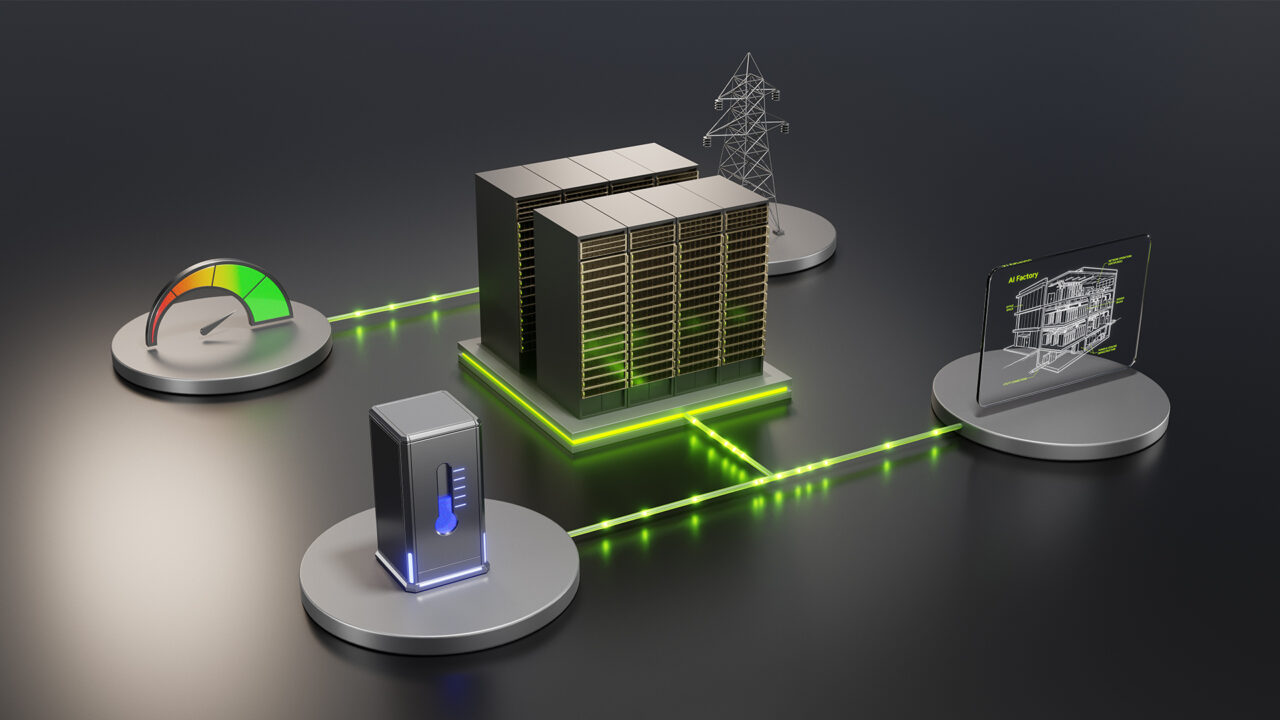
How a grid-aware AI factory can reduce demand
| Flexibility tool | What it does | What cannot be ignored |
|---|---|---|
| Workload shifting | Moves delay-tolerant training, batch inference or maintenance jobs away from constrained periods | Latency-sensitive inference and customer SLAs may need to continue |
| Power caps | Reduces power assigned to lower-priority racks or jobs | Performance impact must be predictable |
| Battery storage | Temporarily reduces grid draw while compute continues | Battery duration, cycling economics and safety |
| Paired generation | Supplies part of the facility load locally | Fuel, emissions, permitting and grid rules |
The easiest workloads to flex are usually the ones with scheduling freedom. A model-training job with a long deadline can tolerate pauses or power caps more easily than a real-time inference service promising a strict response time. That is why workload classification becomes an energy-management problem as well as a compute-scheduling problem.
The most useful proof point: a 4MW load dropped to 3MW while priority jobs continued
NVIDIA describes a commercial flexible-load demonstration involving Emerald AI’s Conductor software and Silicon Valley Power. According to NVIDIA, the utility sent more than 200 demand signals to the participating AI factory. During one described event, Conductor followed a predefined workload hierarchy: lower-priority jobs yielded, higher-priority inference continued, and facility demand fell from roughly 4 megawatts to 3 megawatts without an operator manually intervening.
That is a more useful way to understand flexibility than a percentage headline. The practical value is the ability to make a measurable reduction quickly while protecting the workloads that cannot pause.
NVIDIA is clear that this Santa Clara example is not itself a finished DSX Flex installation. It is an earlier commercial proof point for the pattern DSX Flex is intended to generalize. That distinction matters: the demonstration supports the concept, but it should not be presented as evidence that every AI factory can safely shed the same fraction of load.
“Tokens per megawatt” is becoming an infrastructure metric
NVIDIA is pushing a broader idea: optimize an AI factory for useful compute output per unit of constrained power, not only peak GPU performance. Its DSX MaxLPS software is designed to watch GPU and rack-level power demand and reallocate headroom dynamically instead of provisioning every node as if it were at maximum power simultaneously.
In a Lambda validation cited by NVIDIA, a five-rack deployment ran 19 nodes within the same power budget that would otherwise support 16 nodes at full power. NVIDIA reports roughly 24% more cluster-wide token throughput and a 23% improvement in performance per watt for that test configuration.
These are vendor and partner results, not Digital Pulse Brief benchmarks. They are still instructive because they show the economic direction: when grid power is the bottleneck, unused electrical headroom can be as expensive as an idle GPU.
Why utilities might care
A traditional large industrial load is often planned around a relatively fixed peak requirement. A verified flexible load changes the risk model. If a utility knows that 10, 20 or 30 megawatts can be curtailed under clearly defined conditions, the effective interconnection problem can become easier to manage.
The hard part is trust. Utilities must be able to verify that the promised response actually occurs, that critical grid events take priority over commercial compute schedules, and that the facility will not rebound in a way that creates a second peak after curtailment ends.
AEMA’s performance-based framework is therefore as much about contracts, telemetry and operational rules as it is about GPUs. Flexibility has to be measurable and enforceable before it can meaningfully influence interconnection planning.
Why Google’s participation matters
Google is both a major AI infrastructure operator and a company with extensive experience buying clean energy and optimizing data-center efficiency. Its participation signals that grid-responsive computing is not only an NVIDIA hardware story. For the model to scale, hyperscalers, data-center operators, utilities, energy producers and software schedulers all need compatible ways to describe and verify flexible demand.
The alliance’s value will therefore depend on whether it produces standards and interconnection practices that can be adopted beyond its founding members. A private demonstration can prove feasibility; common rules are what turn the technique into infrastructure policy.
What flexible AI data centers cannot solve
Flexibility does not eliminate the need for new generation, transmission, substations, cooling systems or water-efficient designs. It cannot move every workload, and a data center that is constantly asked to curtail may undermine the economics that justified building it.
There is also a rebound problem. If delayed work simply runs at maximum power immediately after a grid event, part of the benefit can be shifted rather than eliminated. Sophisticated scheduling has to account for the entire load curve, not just the curtailment window.
Finally, “more tokens per megawatt” is not automatically the same as lower environmental impact. The total outcome depends on where the electricity comes from, how often the facility runs, equipment utilization, cooling, embodied hardware costs and whether improved efficiency encourages much more compute demand.
What this changes for cloud and AI infrastructure buyers
For cloud providers and companies planning private AI infrastructure, power management is becoming part of capacity planning. The question is no longer only how many GPUs fit in a rack. Buyers increasingly need to understand the site’s power envelope, what workloads can be interrupted, how scheduling software prioritizes jobs, and whether the utility offers a flexible-load tariff or interconnection program.
That could create a new class of service-level design: latency-critical inference stays protected while lower-priority fine-tuning, batch jobs and synthetic-data generation become dispatchable. In effect, the compute scheduler starts responding to both customer demand and electricity conditions.
Methodology and limitations
This article is based on NVIDIA’s September 2026 reporting on AEMA, DSX and the Emerald AI/Silicon Valley Power demonstrations, plus AEMA’s public mission. Digital Pulse Brief has not independently audited the power telemetry, Lambda benchmark configuration or utility program.
We therefore label performance figures as NVIDIA/partner results and avoid converting the 4MW-to-3MW example into a broader claim about what every data center can shed. The article’s original contribution is the explanation of how workload flexibility changes the infrastructure and interconnection problem.
Bottom line
The most important shift is conceptual: an AI data center does not have to be treated as a perfectly flat block of electricity demand. Some of its compute can be scheduled, slowed or moved, and that flexibility can become a grid service if it is measurable and reliable.
AEMA’s challenge is turning that idea into repeatable rules that utilities trust. If it succeeds, the next generation of AI infrastructure may compete not only on chips and tokens per second, but on how intelligently each facility uses the megawatts it can actually get.
Primary sources
MORE FROM DIGITAL PULSE BRIEF