




The short version: two flagships, one clearly more aggressive
Qualcomm’s 2026 flagship Android silicon is no longer a single chip. The company introduced Snapdragon 8 Elite Extreme Gen 6 and Snapdragon 8 Elite Gen 6 together, both built on an advanced 2nm process and both aimed at premium phones. The Extreme version is the halo part: it pushes harder on on-device AI, graphics, video capture and gaming-oriented memory architecture. The standard Elite Gen 6 keeps much of the same platform foundation for a wider range of premium devices.
That makes the buying question less about “good versus bad” and more about whether a phone maker needs the Extreme silicon’s extra headroom. For most users, the actual phone’s cooling, battery, camera stack and software tuning will matter as much as the badge printed on the spec sheet.
| Area | 8 Elite Extreme Gen 6 | 8 Elite Gen 6 | Why it matters |
|---|---|---|---|
| Process | Advanced 2nm | Advanced 2nm | Efficiency/headroom depends on implementation |
| CPU | Oryon, up to 5GHz | Oryon family | Peak clocks do not equal sustained phone performance |
| AI | More aggressive Hexagon / neural acceleration | Rearchitected Hexagon NPU | Local agentic and multimodal workloads |
| Gaming | Extreme-tier Adreno features and memory support | New Adreno generation | Thermals and OEM cooling decide sustained gains |
| Positioning | Halo / highest-end flagships | Broader premium flagships | Phone price and design may matter more than SoC label |
5GHz on a phone is a milestone — but context matters
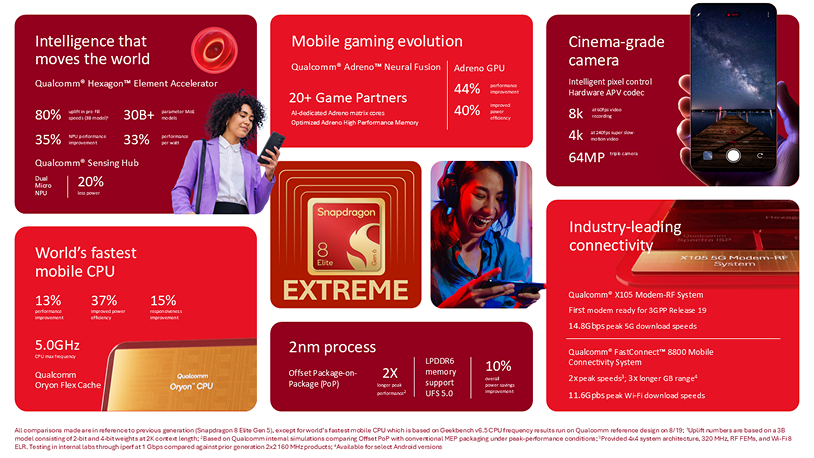
Qualcomm says the Extreme version’s third-generation Oryon CPU reaches 5GHz. That is an eye-catching number for a mobile SoC, and Qualcomm reports a 13% CPU performance uplift for the Extreme platform. But a phone does not run in a benchmark vacuum. Chassis size, vapor-chamber capacity, ambient temperature and the OEM’s power limits determine how long peak clocks can be sustained.
A thin phone tuned for battery life can behave very differently from a gaming phone using the same silicon. That is why Digital Pulse Brief is treating Qualcomm’s launch metrics as vendor-reported platform claims, not as proof that every upcoming 8 Elite Extreme Gen 6 phone will be 13% faster in real use.
The bigger story may be GPU efficiency and sustained gaming
Qualcomm says the new Adreno GPU in the Extreme platform delivers up to 44% higher graphics performance and 40% better power efficiency than its comparison baseline. Those are platform-level claims and need independent device testing, but the efficiency number is potentially more important than the raw peak.
Mobile gaming is usually limited by heat after the first burst. If an OEM can turn additional GPU efficiency into lower power at a given frame rate, it can improve sustained performance and battery life. If it instead spends that efficiency headroom on higher clocks, the phone may simply run faster at similar power. Both outcomes can be useful, but they create different experiences.
Agentic AI is now part of the chip pitch
Qualcomm is explicitly framing both chips around the “agentic AI age.” The Extreme version gets the strongest positioning: Qualcomm says its Hexagon NPU is 35% faster and can deliver up to 33% better performance per watt than the prior comparison platform. The company also describes an improved Sensing Hub, with up to 85% uplift in relevant on-device sensing workloads.
The practical reason this matters is that phones are increasingly expected to run more work locally: transcription, image understanding, camera intelligence, personalized context, language-model inference and small agents that act across apps. Local execution can reduce latency and keep some data on-device, but software support remains the bottleneck. A faster NPU is useful only when Android, the OEM and app developers route meaningful workloads to it.
Camera and video: Extreme pushes into creator territory
Qualcomm says the Extreme platform can support 8K video at 60 frames per second, 4K at 240fps, and the company’s first support for triple 64-megapixel camera pipelines. Those capabilities are technically impressive, but they should not be confused with guaranteed camera quality.
Sensor size, optics, stabilization, image-processing choices, thermal limits and the phone maker’s tuning still determine whether an actual flagship can use those modes well. Recording high-resolution, high-frame-rate video also creates large files and heat quickly. The SoC expands what is possible; the phone design decides what is practical.
X105 modem and Wi‑Fi 8 move connectivity forward
The Extreme platform integrates Qualcomm’s X105 modem-RF system with advertised peak download speeds up to 14.8Gbps and uploads up to 4.2Gbps under ideal supported network conditions. FastConnect 8800 brings support across Wi‑Fi 8, Wi‑Fi 7 and Wi‑Fi 6 generations, with Qualcomm listing peak Wi‑Fi speeds up to 11.6Gbps.
These are theoretical platform ceilings, not what a normal user should expect from a carrier or home router. Real speed depends on spectrum, network deployment, antenna design, congestion, router capability and regional certification. Wi‑Fi 8’s longer-term value is likely to be reliability and efficiency improvements across dense networks rather than a single speed-test headline.
Which phones will use the new chips?
Qualcomm named a broad group of OEMs expected to bring devices powered by the new platforms, including HONOR, iQOO, Motorola, OnePlus, OPPO, REDMI, RedMagic, vivo and Xiaomi. The company’s announcement does not mean every brand will use both versions or that every region will receive the same models.
The most aggressive gaming phones are obvious candidates for the Extreme part because they can spend more chassis volume on cooling and battery. Mainstream premium flagships may prefer the standard Elite Gen 6 if it delivers the right balance of cost, thermals and performance. Final phone announcements will be more useful than assuming the SoC name alone determines the product tier.
Should you wait for an Extreme Gen 6 phone?
If you are buying a premium Android phone primarily for high-frame-rate gaming, local AI experimentation, demanding emulation or advanced video capture, the Extreme version is the one to watch. But waiting makes less sense if your current phone is already a bottleneck and your workload is ordinary messaging, photography, browsing and streaming.
The first-wave devices will also reveal something the launch event cannot: sustained thermals. A 5GHz peak and a much faster GPU are compelling, but the best implementation may be the phone that holds a slightly lower clock for longer while keeping battery drain and surface temperature under control.
Methodology and limitations
Digital Pulse Brief has not independently benchmarked either Snapdragon 8 Elite Gen 6 platform. Specifications and performance percentages in this article come from Qualcomm’s September 22 launch materials and product pages and are identified as vendor claims. We distinguish platform capability from final-device performance because OEM cooling, battery, firmware and camera design can materially change results.
Our analysis focuses on the practical differences buyers should watch for when the first commercial phones arrive.
Bottom line
The Snapdragon 8 Elite Extreme Gen 6 is Qualcomm’s showcase for what a 2nm Android flagship can do when peak performance, local AI, gaming and video are prioritized. The regular Snapdragon 8 Elite Gen 6 shares enough of that architecture that it may end up being the more important chip by volume.
Do not choose a phone on “Extreme” branding alone. Compare the actual device’s cooling, battery, camera implementation, software-update policy and price. The chip defines the ceiling; the phone maker decides how much of that ceiling you can use.
Primary sources
MORE FROM DIGITAL PULSE BRIEF