Claude Sonnet 5.5 vs Opus 5.5: Price, Benchmarks, Coding and Which Model to Use
Claude Sonnet 5.5 is faster and costs half as much per ordinary input and output token as Opus 5.5. But Anthropic still positions Opus as the stronger model for difficult, open-ended work. This comparison explains the pricing, benchmarks, coding trade-offs, context limits, effort settings and the practical point where paying for Opus can make sense.
Research basis: official Anthropic launch posts, model documentation, migration guidance and transparency material, plus independent benchmark context. Digital Pulse Brief has not run an original head-to-head benchmark of Sonnet 5.5 and Opus 5.5.

Official Anthropic visual for the unified Claude workspace. Contextual product image; it is not a Sonnet 5.5 vs Opus 5.5 benchmark chart. Image credit: Anthropic.
Quick answer
For most well-scoped coding, document, support and high-volume API work, Claude Sonnet 5.5 is the more economical starting point. It costs $2 per million input tokens and $10 per million output tokens, compared with $4/$20 for Claude Opus 5.5. Both models expose a 1 million-token context window and 128K standard output, so context size alone is not a reason to choose Opus.
- Start with Sonnet 5.5 when the task is clear, repeatable, latency-sensitive or cost-sensitive.
- Start with Opus 5.5 when the task is ambiguous, long-running, high-stakes or depends on sustained judgment across many steps.
- Do not assume Sonnet always costs exactly half per completed task. Cache reads cost the same on both models, and effort settings can change token usage.
- Do not treat one benchmark win as a universal verdict. Anthropic says Opus remains clearly stronger on complex, open-ended work requiring sustained judgment.
Why this comparison matters now
Anthropic released Claude Opus 5.5 on September 22, 2026 and Claude Sonnet 5.5 six days later on September 28. Sonnet arrived close enough to Opus on several published evaluations that the old “cheap model for simple work, expensive model for serious work” rule is no longer useful. The better question is how much judgment the task needs, how easy the result is to verify, and what a failed attempt costs.
This is also a distinct search intent from Digital Pulse Brief’s existing Claude Opus 5.5 explainer. That article focuses on the Opus launch itself; this one focuses on the choice between the two current Claude 5.5 tiers.
Claude Sonnet 5.5 vs Opus 5.5: core specifications
Claude Sonnet 5.5
Released: September 28, 2026
Model ID: claude-sonnet-5-5
Context: 1M tokens
Standard max output: 128K tokens
Input / output: $2 / $10 per 1M tokens
5-minute cache write: $2.50 / 1M
1-hour cache write: $4 / 1M
Cache read: $0.20 / 1M
Thinking: Adaptive
API default effort: High
Comparative latency: Fast
Claude Opus 5.5
Released: September 22, 2026
Model ID: claude-opus-5-5
Context: 1M tokens
Standard max output: 128K tokens
Input / output: $4 / $20 per 1M tokens
5-minute cache write: $5 / 1M
1-hour cache write: $8 / 1M
Cache read: $0.20 / 1M
Thinking: Adaptive, always on
API default effort: Medium
Comparative latency: Moderate
Both models accept text and image input and output text. Anthropic lists a June 2026 reliable knowledge cutoff for both, documents up to 300K output tokens in the Batch API beta, and makes both available through the Claude API, Amazon Bedrock, Google Cloud, Microsoft Foundry and Claude Platform on AWS.
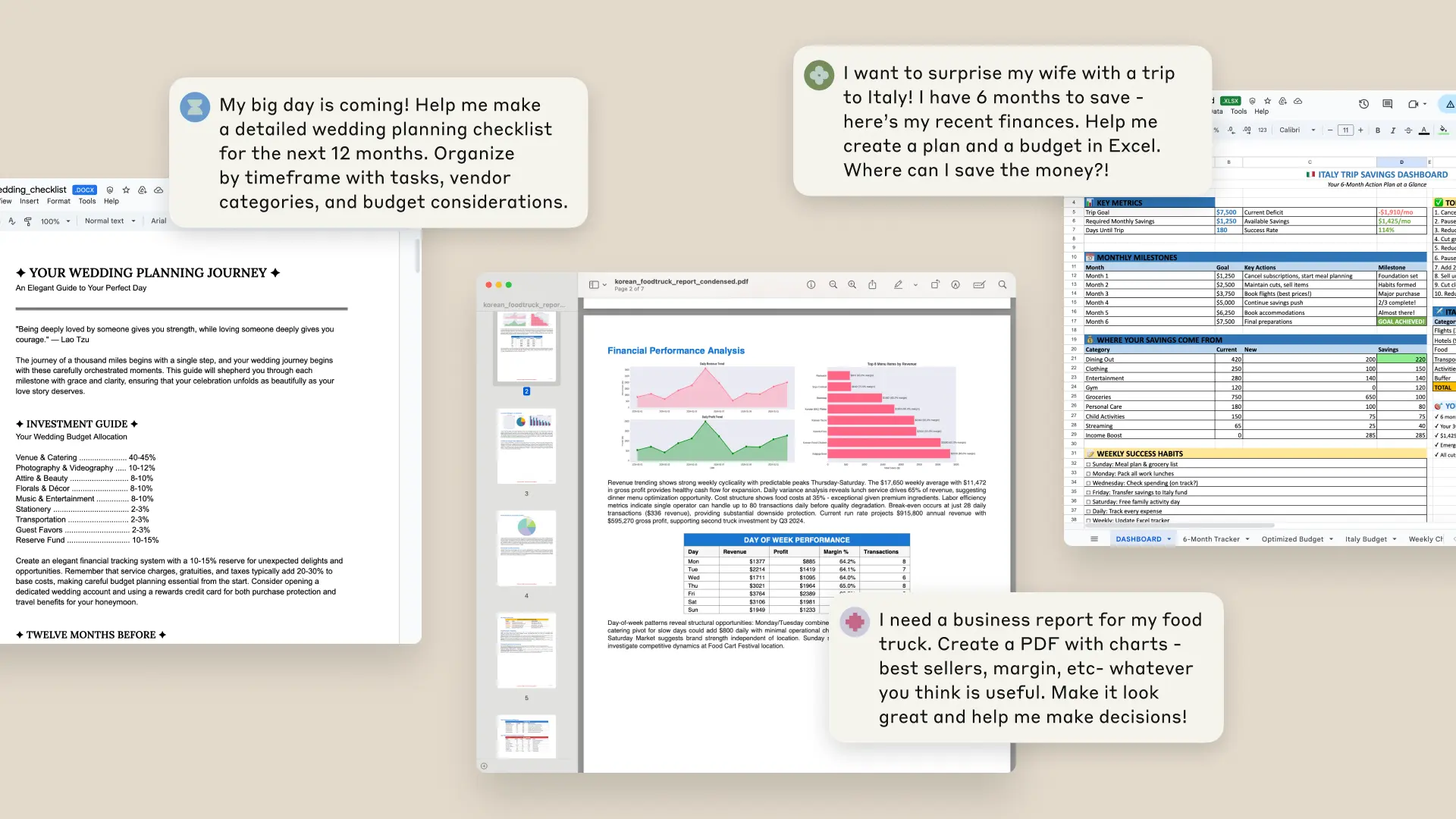
Official Claude file-creation workflow. Sonnet 5.5 is specifically positioned for polished documents, slides and spreadsheets. Image credit: Anthropic.
Sonnet 5.5 is half the standard token price — but task cost is more complicated
The rate-card difference is straightforward. Sonnet 5.5 costs $2 per million input tokens and $10 per million output tokens. Opus 5.5 costs $4 and $20. Five-minute prompt-cache writes cost $2.50 on Sonnet and $5 on Opus; one-hour cache writes cost $4 and $8. Both receive a 50% Batch API discount on input and output.
If a workload consumes 10 million uncached input tokens and 2 million output tokens, the standard token bill is about $40 on Sonnet 5.5 and $80 on Opus 5.5, before tools or platform-specific charges. That example illustrates the 2:1 rate difference, not a guarantee that every finished task will cost exactly half.
Why cache-heavy agents narrow the gap
Cache reads cost $0.20 per million tokens on both models. A workload with 50M cache-read tokens, 5M uncached input tokens and 1M output tokens comes to roughly $30 on Sonnet 5.5 and $50 on Opus 5.5 at list prices. The uncached token rates are still 2:1, but the total bill is not.
Effort level matters too. Anthropic plots benchmark score against cost per task at several effort settings and says Sonnet complements Opus best at lower settings, where it can deliver strong results at substantially lower cost. At the highest settings, comparable performance can arrive at comparable cost because the cheaper model may reason longer or produce more tokens.
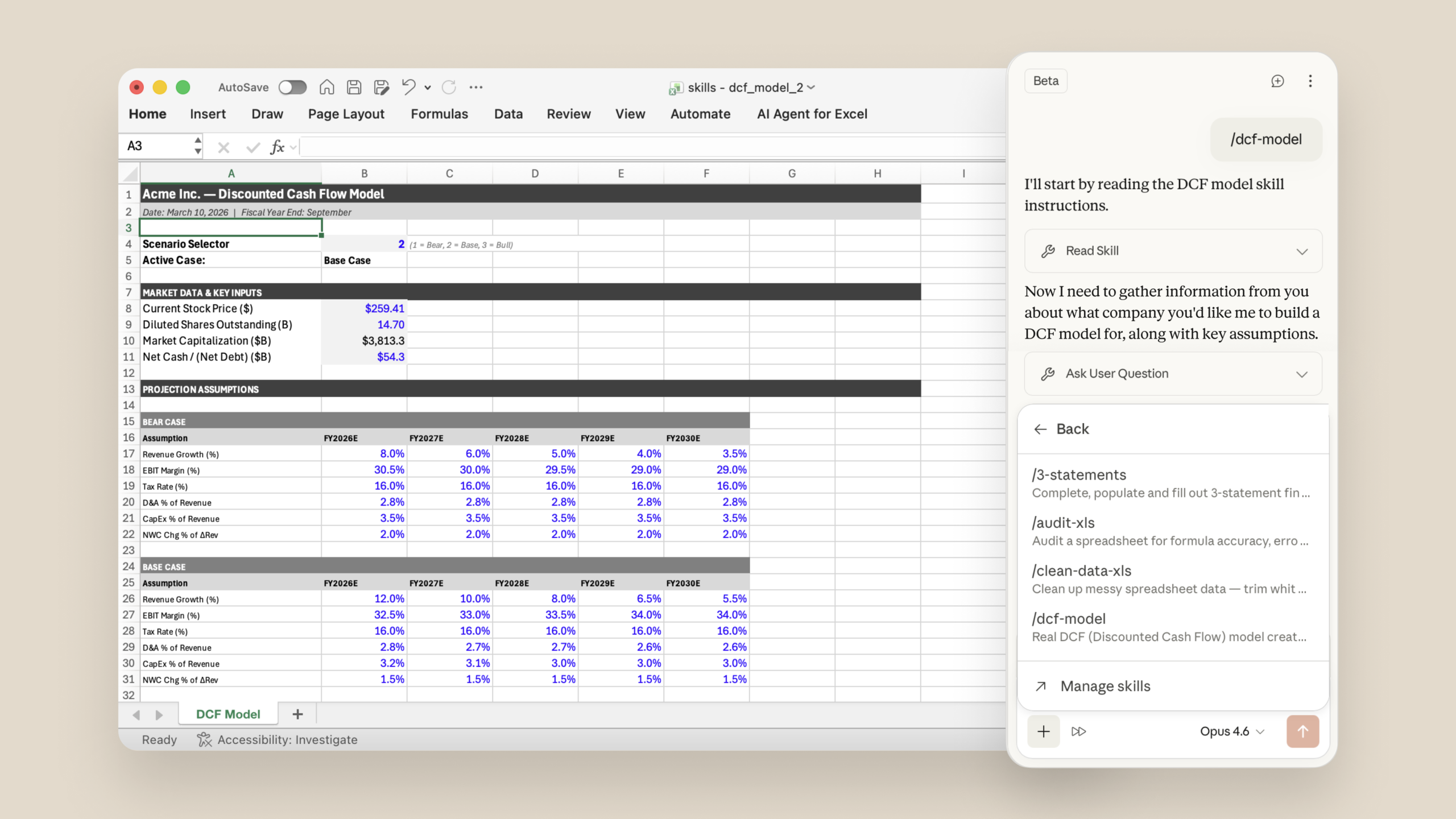
Official Claude visual showing cross-file work between Excel and PowerPoint. Image credit: Anthropic.
Benchmarks: Sonnet gets very close to Opus, but the pattern is mixed
Anthropic’s September 28 launch table reports several notable head-to-head results. These are vendor-published benchmark results, not Digital Pulse Brief testing, and some figures use different effort settings or benchmark-specific caveats.
- Terminal-Bench 4.0: Sonnet 5.5 70.6% vs Opus 5.5 66.4% at the reported best setting.
- FrontierCode 1.1: Sonnet 5.5 46.2% vs Opus 5.5 54.4%.
- CursorBench 4.0: Sonnet 5.5 55.5% vs Opus 5.5 57.8%.
- GDPval-AA v2.1: Sonnet 5.5 1844 vs Opus 5.5 1846.
- AA-Briefcase v1.1: Sonnet 5.5 1811 vs Opus 5.5 1822.
- OSWorld 2.1: Sonnet 5.5 80.1% vs Opus 5.5 81.8%.
The result is not a simple Sonnet win. Sonnet leads the reported Terminal-Bench result, while Opus leads FrontierCode, CursorBench and several professional-work comparisons by varying margins. Anthropic explicitly cautions that benchmarks capture only one facet of capability and says Opus 5.5 remains clearly stronger on complex, open-ended work that requires sustained judgment.
Independent benchmark aggregator Artificial Analysis currently shows a similar trade-off: Opus 5.5 reaches a higher top intelligence score in its release comparison, while Sonnet 5.5 is faster at output generation. That is consistent with Anthropic’s product positioning, although independent measurements can change as providers update models and test configurations.
Claude Code terminal interface. This screenshot predates Sonnet 5.5 and is used to illustrate the coding workflow, not to claim a model-specific result. Source/credit: Claude by Anthropic.
For coding and agents, choose by task shape
Sonnet 5.5 has the strongest economic case when the job is well specified and easy to validate: fixing a reproducible bug, implementing a defined feature, updating tests, transforming data, reviewing a bounded change, or running repetitive agent steps where latency compounds. In those situations, half-price ordinary tokens and faster latency can matter more than a modest capability gap.
Opus 5.5 is more compelling when the model has to discover the problem before it can solve it. Large migrations, unfamiliar architectures, ambiguous incidents, multi-system investigations and planning tasks can reward stronger judgment because a wrong early decision creates expensive retries later.
A practical production pattern is to validate Sonnet 5.5 against your own acceptance tests first, then escalate failures or unusually ambiguous jobs to Opus 5.5. This gives a team a measurable routing policy instead of assuming the most expensive model should handle every request.
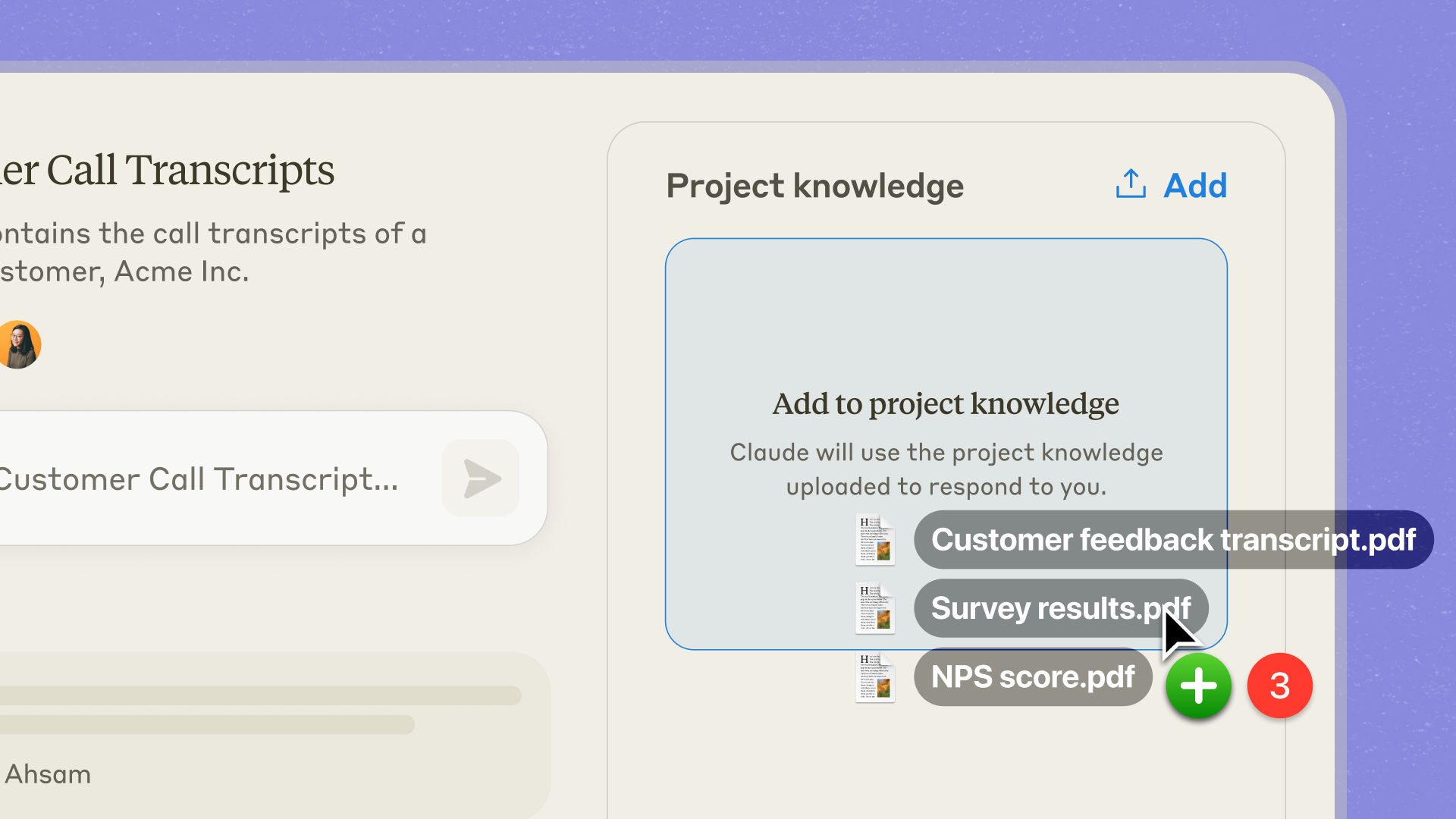
Claude Projects interface showing project knowledge uploads. Both Sonnet 5.5 and Opus 5.5 have a 1M-token context window, so context capacity alone does not distinguish them. Source/credit: Claude by Anthropic.
For documents and business work, Sonnet closes much of the gap
Anthropic highlights documents, slides and spreadsheets as Sonnet 5.5 strengths. On GDPval-AA, a professional-work benchmark spanning many occupations, Anthropic reports 1844 for Sonnet 5.5 and 1846 for Opus 5.5. A near tie on one benchmark does not prove equivalent quality in every workplace task, but it helps explain why Sonnet is being positioned as an everyday production model rather than only a cheaper coding engine.
For repeatable research summaries, support drafting, spreadsheet assistance, document transformation and templated analysis, Sonnet’s speed and cost are attractive. Opus is the stronger escalation option when the brief is vague, the source material conflicts, or success depends on nuanced synthesis rather than straightforward execution.
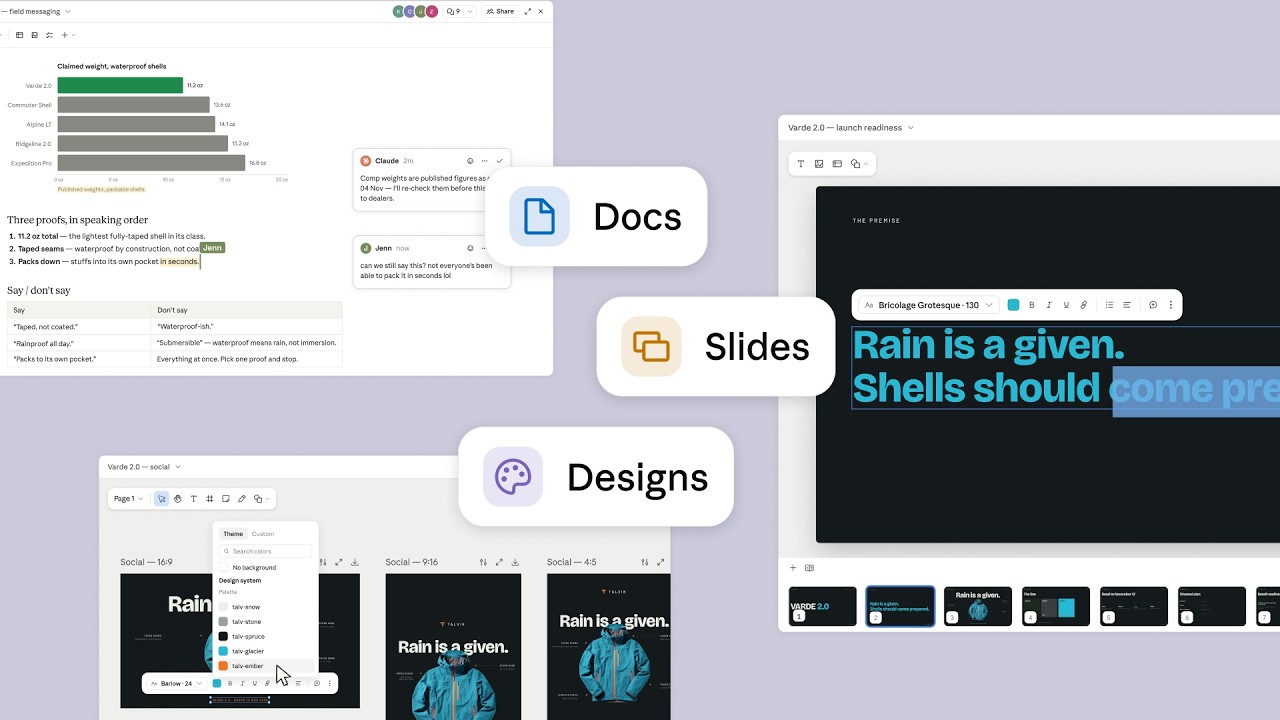
Official Anthropic visual introducing Claude Docs, Slides and Design. Contextual product imagery; it is not a Sonnet 5.5 benchmark screenshot. Image credit: Anthropic.
Context window and output limits are effectively tied
Anthropic’s current model documentation lists a 1 million-token context window and 128K standard maximum output for both models. Both also document up to 300K output tokens in the Batch API beta. That means “I need the largest context” is not a reason to default to Opus 5.5.
The important differences are how much reasoning a task needs, the latency you can tolerate, how much token use the selected effort level creates, and the cost of failure or human review. Two models can have identical context limits while producing very different economics on the same workflow.
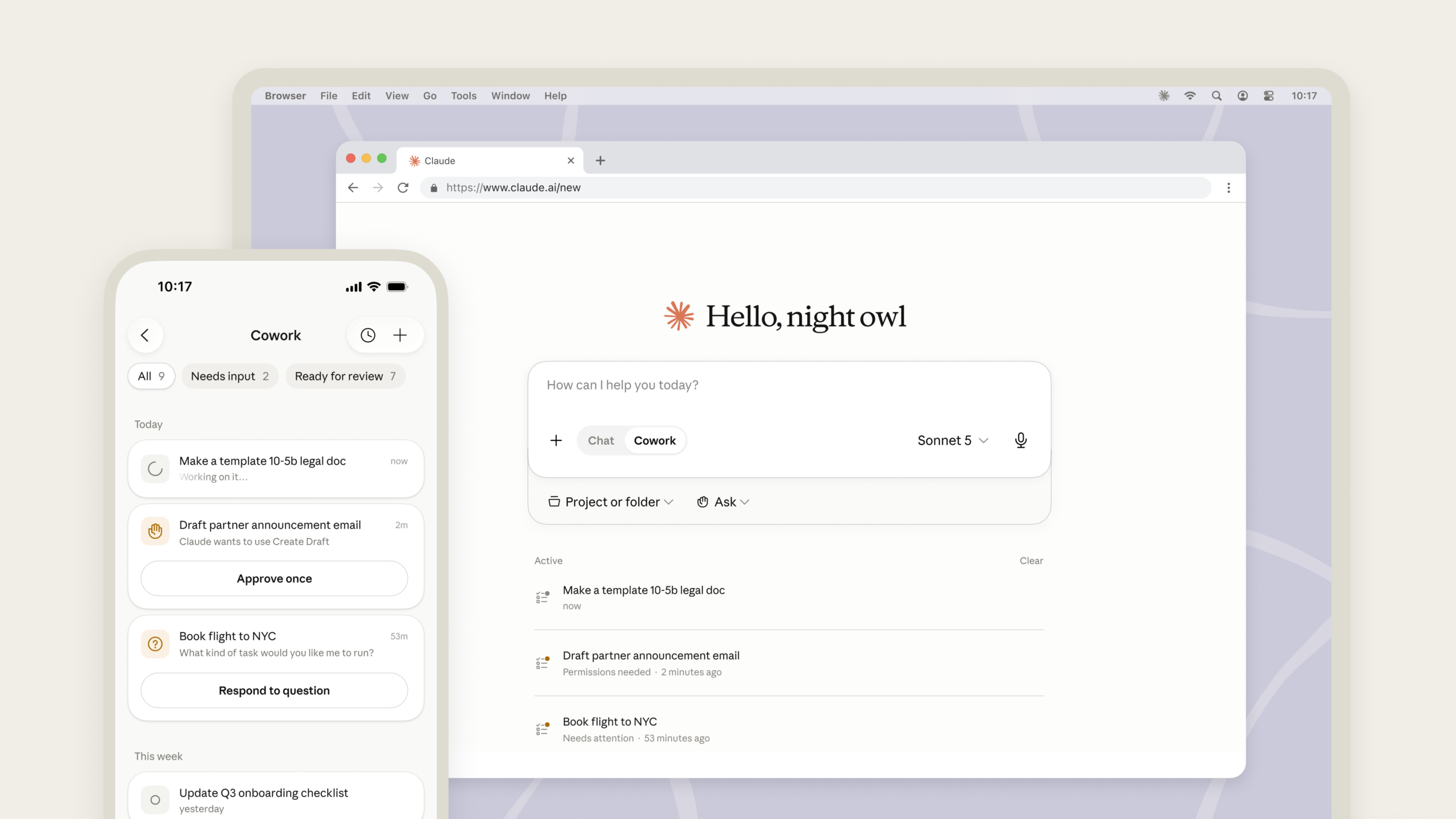
Official Claude Cowork visual across web and mobile. Subscription access in Claude products and API billing are separate considerations. Image credit: Anthropic.
Effort settings can change the comparison more than the model name
Anthropic lists Sonnet 5.5 with adaptive thinking and a high default effort on the Claude Platform, while Opus 5.5 uses adaptive thinking that is always on and defaults to medium effort. In the Claude apps, Anthropic says the default effort is medium. More effort generally means more reasoning, higher latency and greater task cost.
This is why dollars per million tokens should not be the only routing signal. A lower-priced model at a much higher effort setting can consume enough additional work that the expected savings shrink. Production comparisons are strongest when teams measure completed-task cost at a target quality level.
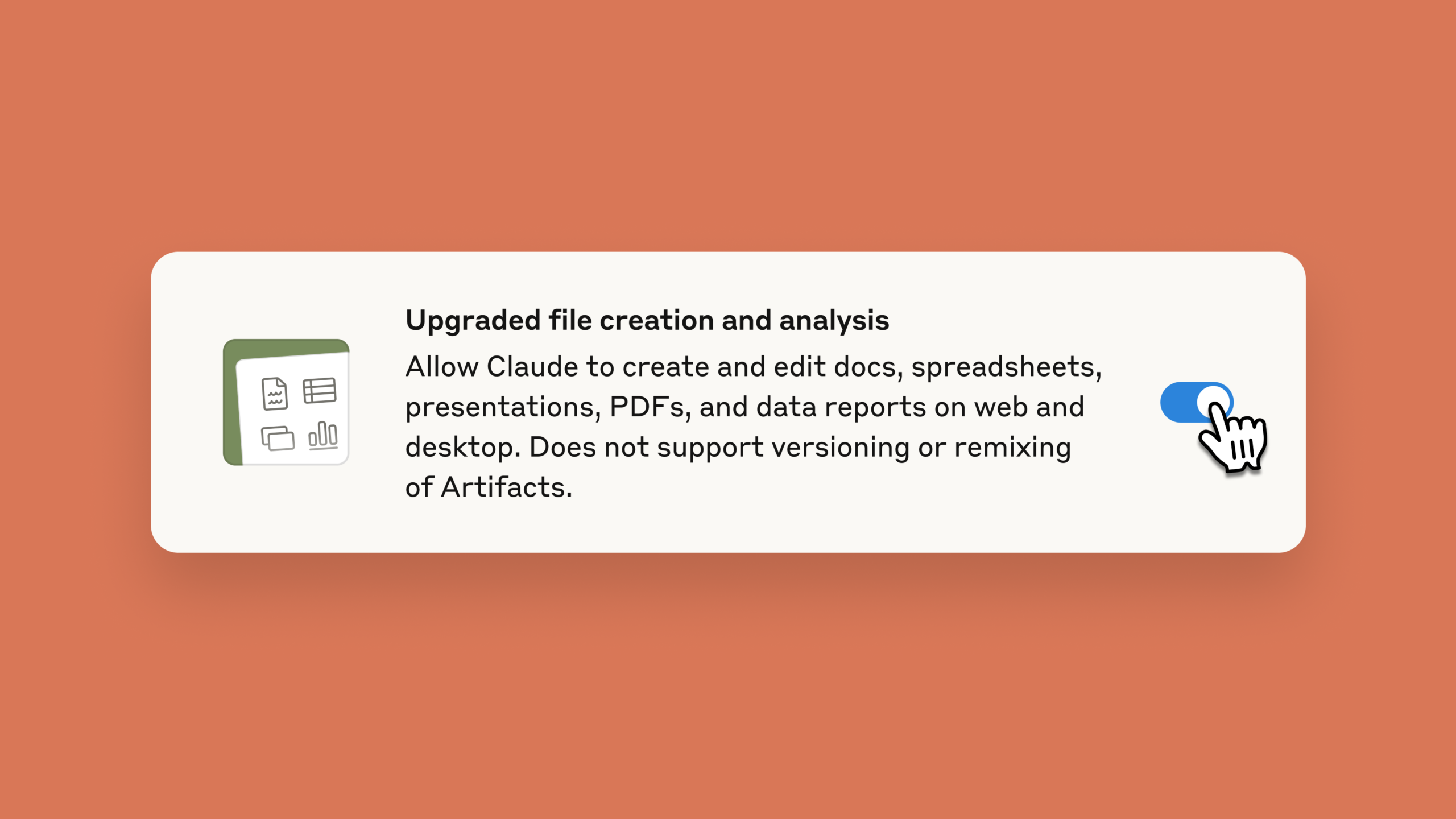
Official Claude settings visual. Product configuration can change the user experience independently of the underlying model. Image credit: Anthropic.
Developers should test migration behavior, not only change the model ID
Sonnet 5.5 is available as claude-sonnet-5-5 and Opus 5.5 as claude-opus-5-5 across Anthropic’s major supported platforms. But Anthropic’s migration guidance documents behavior changes that can affect production integrations.
- Code that disabled Sonnet 5 thinking should review the new between_tools behavior.
- Forced tool-choice patterns using any or a named tool need review; Anthropic directs developers toward automatic selection with strict tool use.
- Thinking blocks are tied to the model and conversation history, so editing earlier history and replaying preserved thinking can cause errors.
- Older computer_20251124 computer-use integrations on the Claude API or Google Cloud need migration.
- Interfaces that surface text between tool calls should review the current thinking-display behavior.
Safety and safeguards are part of the product decision
Anthropic says Sonnet 5.5 is the first Sonnet model to launch with cyber safeguards and fallbacks similar to those used for its most capable models because its cybersecurity capabilities improved substantially. The company’s October 2 Transparency Hub says Sonnet 5.5 improved or matched Sonnet 5 on most measures in its automated behavioral audit, while Opus 5.5 still performed slightly better overall across that audit.
Those are vendor evaluation results, not proof that either model is “safe” in an absolute sense. Teams deploying agents that can execute code, access customer data or act on business systems still need permission boundaries, logging, human review for consequential actions, and workload-specific testing.
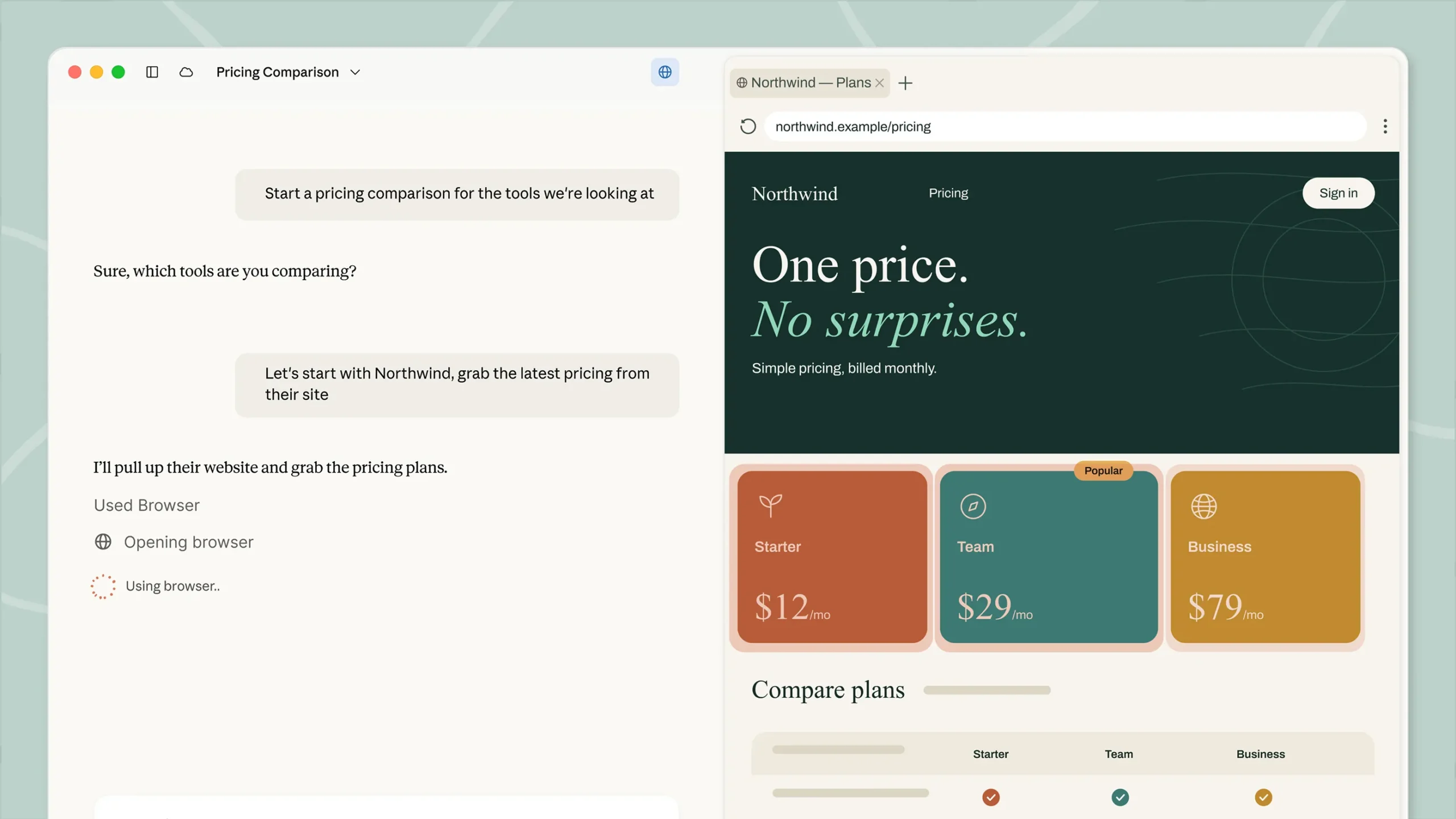
Claude Cowork built-in browser interface illustrating agentic web tasks. Source/credit: Claude by Anthropic.
Which Claude 5.5 model should you use?
A useful decision rule is to route by task shape and the cost of failure. Start with the cheaper model when the work is clearly specified and easy to verify. Start with the stronger model when defining the work is itself part of the problem.
Choose Sonnet 5.5 when
- The task has a clear specification and objective checks.
- You run high-volume API or agent workloads.
- Interactive latency matters.
- You do routine bug fixes, support, document work, transformations or repeated analysis.
- Your own evaluation shows Sonnet meets the quality bar without expensive retries.
Choose Opus 5.5 when
- The task is ambiguous, novel or expensive to get wrong.
- You need sustained judgment across a long agentic workflow.
- The model must make architectural or strategic trade-offs with incomplete information.
- Your testing shows Opus reduces retries, review time or failure cost enough to justify the premium.
- You want Anthropic’s strongest current Opus behavior rather than its fastest 5.5 option.
For many organizations, the most sensible answer is a two-tier routing policy: Sonnet 5.5 for normal workloads and Opus 5.5 for escalation. That can preserve most of Sonnet’s cost and latency advantage while keeping Opus available for the jobs where deeper judgment is worth paying for.
Frequently asked questions
Is Claude Sonnet 5.5 cheaper than Opus 5.5?
Yes for standard uncached API input and output. Sonnet 5.5 is $2/$10 per million input/output tokens; Opus 5.5 is $4/$20. Cache reads are $0.20 per million tokens on both, so a cache-heavy workload will not always cost exactly half.
Do Sonnet 5.5 and Opus 5.5 have the same context window?
Yes. Anthropic currently documents a 1 million-token context window and 128K standard maximum output for both.
Is Sonnet 5.5 better than Opus 5.5 for coding?
Not universally. Sonnet leads Anthropic’s reported Terminal-Bench 4.0 result, while Opus leads FrontierCode and CursorBench. Anthropic still describes Opus as stronger for complex, open-ended work requiring sustained judgment.
Should developers migrate from Sonnet 5 without testing?
No. Anthropic documents migration changes around thinking, tool choice, preserved conversation history, computer-use tooling and streamed reasoning behavior. A model-ID change can affect integration behavior even when prompts remain the same.
Sources and research basis
Digital Pulse Brief checked Anthropic’s Sonnet 5.5 launch announcement, Sonnet 5.5 model documentation, Anthropic’s Opus 5.5 launch announcement, Opus 5.5 model documentation, Anthropic’s Sonnet 5.5 migration guidance, and the Anthropic Transparency Hub. For independent context, DPB also reviewed Artificial Analysis. Benchmark and efficiency figures are attributed to their sources; DPB did not conduct hands-on testing.
Related DPB coverage: Claude Opus 5.5 pricing, benchmarks and safety · Claude Pro review 2026 · Claude Docs and Slides. For factual corrections, see Digital Pulse Brief’s Editorial Standards and Contact pages.